
Research & recollections
Articles
Pieces on village life — an ARP team, a family's memories of the railway cottages, and Richard Tanner's histories of the buses, roads and railways that changed these villages.
ARP Team
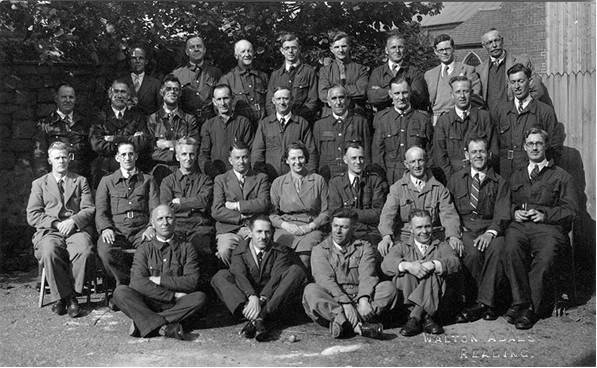
Can anyone confirm if this was taken in 1939/40 when Gordon Cunningham, in glasses seated on right, was living in Steventon and the manor was requisitioned for civil defence training?
Linda Rea on her Father from South Litchfield
My grandparents and their young daughter moved to number 1 Railway Cottages just after WW1 — the furthest one on the right when facing them (north end). My grandfather was a signalman and moved from Middlesex to work in the signal box which stood just on the Basingstoke side of the tunnel. It must have been a real culture shock after the busy streets they had been used to. My father was born at the cottage. The family moved to Oakley around 1929 when my grandfather moved to the 'Wootton' box which stood close to the cricket park.


No 1 Railway Cottages sits above the tunnel. From his memories as a young boy, my elderly father says a family named Smith lived next door; Mrs Smith was the caretaker for the mission hall (photo) opposite which was the well which provided their water supply (photo). A railway pensioner lived at No 3 who walked each week to Micheldever Station to collect his small pension, and another railway worker and his wife at No 4. At aged 7 at the most Dad walked across the fields to Steventon School. A local business in Overton delivered grocery orders and my grandmother walked to Ashe crossroads to get the bus or Micheldever Station for the train.
His father was a signalman who worked mostly at the local box. The line traffic was more seasonal then, with the lines busier in the summer with holiday visitors. In quieter winter times his father would have to cycle to Worting to cover the box there instead. During WWI, Grandfather was a farrier and harness maker. He still had his tools and in his spare time mended harnesses for the people at Litchfield Grange.
Our Buses
In 1926, Maurice Allen's 'Steventon Pride' ran a weekday morning service from Waltham Barracks through North Waltham, Steventon, Oakley and Worting to Basingstoke, and a Mondays-only trip from Steventon to Winchester via North Waltham. At the same time, Thornycroft began using their 20 seaters to carry their workers and Wallis Steevens during the General Strike, a service which extended from Basingstoke to Andover along the B3400 in 1928, competing with King Alfred's from Winchester through the 1930s.
Serving Basingstoke, their bus company, Ventura, had started Route G to Steventon via the A33, Dummer and North Waltham daily by 1930. Applications for a route to Winchester were challenged not only by O Porter operating out of Dummer and King Alfred Motor Services from Winchester, but even by the L&SW Railway.
WWII restrictions had two effects: the replacement of Thornycroft's single deckers with doubles to take the increased traffic, and the circular Route 10 from June 1940 to April 1946 from Basingstoke through Kempshott, Dummer, Popham, North Waltham, Steventon, Oakley and Worting.
After the war, Route 11 to Winchester through Dummer and North Waltham became a high status one for Ventura, running 5 times daily until 1950. Steventon, left out, had to rely on the local Basingstoke service No 10 via Oakley and the Beach Arms, which was abandoned by Wilts and Dorset in 1959. People then had to walk to the Deane Gate to catch the half-hourly Andover/Winchester and Overton buses to Basingstoke.
Student Travel Services started in 1964 to serve junior children transferred to North Waltham with the closure of Dummer and Steventon schools, and to get senior students to Basingstoke colleges. This continues today, together with subsidised contract services, formerly by Countrywide and now by STS.
I hope readers are interested in me sharing such snippets from our Victoria County History research and will correct and add to the information offered. Have you any comments, stories or pictures about buses to share with us?
Early Roads
Was it because the roads were so bad that villages like ours were self-sufficient, or because villages produced everything the people needed that roads were so poor? Whichever, we had the drove road taking sheep to London — the Harrow Way — following Brian Spicer's 'Tin Road' (nwsadhs 22 Oct 09). This ran from Clarken Green (Beach Arms) through Ashe Warren and Polhampton, carrying one weekly waggon from Andover to London. The other London–Exeter route followed the Roman road past the Wheatsheaf through Stockbridge.
Turnpikes spread west from Basingstoke in the 1750s. One redirected the Clarken Green route through Deane and Ashe to Overton (B3400), while the other came up Kempshott Hill to split at the Wheatsheaf and go towards either Sutton Scotney or Winchester (A33). The first became the main route from the South-west, relaying our success at Trafalgar in 1805, though the side roads off it were pretty dire. James Austen recalls his mother having to recline on a feather mattress in the cart moving the family from Deane to Steventon in 1771.
Turnpiking certainly speeded journeys up. London to Exeter was reduced from 4 to 3 days in summer, though the price increased from 2d to 3d a mile. With the arrival of the Basingstoke Canal, waggon trade increased, collecting grain for London and distributing bricks and timber for building, and the London and Southampton railway brought even more turnpike traffic until the opening of the Andover line in the 1850s.
With more wealth and knowledge, villagers came to need goods from outside, so the carrier trade developed. While Ashe and Deane were served by the main road between Overton and Basingstoke, North Waltham and Steventon came to depend on carriers to Basingstoke and Winchester running on market days, a practice that only died out with Harvey Bolton in 1965, long after the buses had arrived (see Oct 09 mag).
Do please add or amend information to our VCH research.
Our Trains
By 1830, some thirty stagecoaches a day were passing through Basingstoke, a major business now under threat. The world's first public railway had just opened between Manchester and Liverpool, and the London and Southampton Railway company called a meeting of local dignitaries in 1832. Though Basingstoke wasn't on the main route to Southampton which went through Farnham, the L&SR hoped to build a line onto Bath and Bristol before the Great Western.
Having been persuaded that the London, Maidenhead, Reading and Newbury route would destroy Basingstoke's trade to the West, Sir Thomas Baring set about raising one million pounds. Subscribers to the £50 shares were promised 10% profit a year plus the benefit of travel at 20mph. The plans were drawn, the 1834 Act passed, the money raised and the land purchased, so building started from each end. The Micheldever tunnel collapse delayed the opening until 1840.
Nine trains a day left Nine Elms, seven for passengers taking 3–4 hours for the 73 mile journey and two for goods taking 6 hours, a dramatic improvement on horse-drawn times. Prices stayed high, 12/- single London to Basingstoke for fast trains, 7/- for second class and 4/- for third, with parcels at 1/- under 28lb and 1/6d for 28–56lb. After Basingstoke, there were only 3 stations: Andover Road (now Micheldever), Winchester and Southampton.
Pressure from Andover led to the Basingstoke–Salisbury Act of 1846 but, after the 1848 depression stopped work, it needed another Act in 1853 to link Andover in 1854, Salisbury in 1857 and Exeter in 1860, long after Brunel's West Country route had opened. Growth of use allowed the line from Basingstoke to Andover to be doubled, but it still took 1½ hours to cover the 36 miles to Salisbury, stopping at Oakley, Overton and Whitchurch.
Under pressure from Portsmouth, the L&SR changed its name to the London and South Western Railway. As business grew, Nine Elms became too crowded, but the burghers of Basingstoke junction turned down the chance to have the railway workshops, which went instead to Eastleigh. The broad gauge link to Reading was opened by the Great Western in 1870 and the early 20c saw the Light Railway to Alton come and go twice.
Basingstoke's coaching trade disappeared in favour of commerce and industry, first agricultural, then clothing and engineering. Farms in Steventon, Ashe and Deane were split in new ways. The huge navvy-made embankments and cuttings built for weak locomotives to cross the downs allowed Lord Nelsons to exceed 100mph downhill. Now electrified, Battledown has a train passing every 5 minutes during commuter rush hours. 160 years of change.