In brief
- George Lefroy was rector of Ashe from 1783 to 1806, and his wife Anne was a close older friend of the young Jane Austen.
- George's nephew Tom Lefroy flirted with Jane at Ashe in the winter of 1795–96 and later became Lord Chief Justice of Ireland.
- Anne Lefroy died after a riding accident on 16 December 1804, Jane's birthday; Jane wrote a poem in her memory in 1808.
- Jane's niece Anna Austen married Ben Lefroy in 1814, and Ben later became rector of Ashe.
- Ashe church was mostly rebuilt in the late 1870s, but Lefroy memorial tablets survive inside.
Contents
- The rector and his wife
- Anne Lefroy and the young Jane Austen
- Tom Lefroy and the winter of 1795–96
- Anne Lefroy's death and Jane's poem
- The next generation: Anna Austen and Ben Lefroy
- The Lefroys and the Austens: who was who
- What survives at Ashe church
- Visiting and further research
- Frequently asked questions
For a few years either side of 1800 the rectory at Ashe was one of the busiest social houses in this corner of North Hampshire. It was the home of the Reverend George Lefroy and his wife Anne, and it stood barely two miles from Steventon rectory, where Jane Austen was growing up. The Lefroys provided Jane with books, conversation, dances and, in the winter of 1795–96, an Irish visitor she did not altogether forget. A generation on, the families were joined by marriage when Jane's niece Anna married a Lefroy son who later became rector of Ashe himself. This article sets out what is reliably known about the family, tries to keep the documented facts apart from the romance that has gathered round them, and suggests what a visitor to Ashe can still see.
The rector and his wife
The Reverend Isaac Peter George Lefroy
Isaac Peter George Lefroy (1745–1806), always called George, came of a family of Huguenot descent. He became rector of Ashe in 1783 and kept the living until he died in 1806. Like many Georgian country clergy he was a gentleman of some means and education, not a humble parish priest, and under him the rectory was a sociable house with a growing family. What contemporaries say of him is generally respectful and generally short. It is his wife who fills the surviving accounts.
Anne Lefroy, "Madam Lefroy"
Anne Lefroy was born Anne Brydges in 1749 (some sources say 1748) and married George Lefroy in 1778. Her brother was the writer and genealogist Sir Samuel Egerton Brydges, and she had the same literary bent: she wrote verse, read a great deal, and was admired round about for her wit and charm. Locally she was "Madam Lefroy", which says something about her standing in Ashe and the neighbouring parishes.
Accounts written after her death, many by members of the family, also describe her practical charity in the village. She is said to have taught poor children to read and to have vaccinated a good number of local people against smallpox with her own hands. These stories come mostly from family tradition, so the details should be taken with some caution, but they fit the picture of an energetic rector's wife with a strong sense of public duty.
Anne Lefroy and the young Jane Austen
Jane Austen was born at Steventon in December 1775, about a quarter of a century after Anne Lefroy. The two households were near neighbours, and Jane went often to Ashe rectory, to parties and dances there and at Ashe Park close by. A clever girl in a country parsonage did not often meet an older woman who wrote poetry, lent books and would talk seriously about literature.
"Influence" is hard to measure, and biographers disagree about how much weight to give it. Three things can be said with some confidence:
- Anne Lefroy was one of very few women outside Jane's own family whom Jane is known to have admired deeply;
- the friendship lasted through Jane's formative years, from girlhood until she left Steventon for Bath in 1801;
- the poem Jane later wrote in her memory shows that the attachment was still strong four years after Anne's death.
Some writers have suggested that Mrs Lefroy was a mentor of sorts, encouraging Jane's reading and perhaps her early writing. That is a fair inference, but it rests on the general nature of the friendship, not on anything either woman is known to have said directly.
Tom Lefroy and the winter of 1795–96
The visit
Thomas Langlois Lefroy (1776–1869) was the Reverend George Lefroy's nephew. Irish-born and a student at Trinity College Dublin, he stayed at Ashe over Christmas 1795 and into January 1796 before going on to read law in London. He was almost exactly Jane's age.
He comes up several times in Jane's letters to her sister Cassandra in January 1796, which are among the earliest of her letters to survive. She writes teasingly about dancing and sitting down together, about his good looks and gentlemanlike manners, and about expecting an offer from her "friend", before announcing, tongue in cheek, that she means to refuse him. The tone is light and self-mocking, very much her own. It is a record of a flirtation, written for a sister who would see the jokes.
What happened next
Tom left Hampshire in January 1796, and nothing came of it. Neither family could afford an early marriage. Tom was expected to make his way at the law and to help his own large family, and Jane had no fortune. It is often said that Mrs Lefroy, seeing the difficulty, made sure the two did not meet again. That is plausible and has been repeated many times, but the evidence that she actually stepped in is thin.
Jane mentions Tom once more in a letter of 1798, remarking that his aunt had not spoken of him when she called. He married Mary Paul in 1799 and had a long and distinguished career, sitting as Member of Parliament for Dublin University, becoming a judge, and serving as Lord Chief Justice of Ireland from 1852 to 1866. He died in 1869 at the age of 93. In old age, according to a family relation, he admitted that he had once loved Jane, though it had been "a boy's love". The story was published long afterwards and is best treated as family recollection.
A great deal has been added to the episode since, most famously in the 2007 film Becoming Jane, which makes up much of its plot. The documentary record amounts to a few lively paragraphs in two or three letters.
Anne Lefroy's death and Jane's poem
Anne Lefroy died on 16 December 1804, Jane Austen's twenty-ninth birthday, after being thrown from her horse. The Austens were living in Bath by then, and Jane heard the news from a distance. The accident shocked the neighbourhood. George Lefroy outlived his wife by little more than a year and died in 1806.
Four years later, on her birthday in 1808, Jane wrote a poem headed with her friend's name and the date of her death, observing that it was her own birthday too. Over a series of stanzas it recalls Anne's character, mind, manner and kindness, and it is among the most deeply felt verse Jane is known to have written. It can be found in collected editions of Austen's minor works and is well worth reading next to the letters.
The next generation: Anna Austen and Ben Lefroy
George's death did not end the Lefroys' connection with Ashe. His son John Henry George Lefroy succeeded him as rector, and in time the living went to the youngest son, Benjamin, generally known as Ben (1791–1829).
In November 1814 Ben married Anna Austen (1793–1872), elder daughter of Jane's eldest brother James, who had followed his father as rector of Steventon. The marriage went ahead in spite of some misgivings in the family, and it tied the two clerical households together again. Anna wanted to be a novelist, and during 1814 Jane sent her a run of letters with comments on her manuscript. They include some of Austen's best-known remarks on writing fiction, among them the advice that "3 or 4 Families in a Country Village is the very thing to work on".
Ben went into the Church and later became rector of Ashe, where he stayed until his early death in 1829. Anna was left a widow with young children. She lived until 1872 and in later life added her own memories to the family's recollections of her famous aunt. Sources give different dates for Ben's incumbency, so anyone looking at it closely should check the Ashe registers and the diocesan records at the county record office.
The Lefroys and the Austens: who was who
| Person | Dates | Connection |
|---|---|---|
| Rev. Isaac Peter George Lefroy | 1745–1806 | Rector of Ashe 1783–1806; husband of Anne |
| Anne Lefroy (née Brydges) | 1749–1804 | "Madam Lefroy"; friend of Jane Austen; died after a riding accident |
| Sir Samuel Egerton Brydges | 1762–1837 | Anne's brother; author and genealogist |
| Thomas Langlois (Tom) Lefroy | 1776–1869 | Nephew of George; visited Ashe 1795–96; later Lord Chief Justice of Ireland |
| Rev. John Henry George Lefroy | 1782–1823 | Son of George and Anne; succeeded his father at Ashe |
| Rev. Benjamin (Ben) Lefroy | 1791–1829 | Youngest son; married Anna Austen; later rector of Ashe |
| Anna Lefroy (née Austen) | 1793–1872 | Jane's niece, daughter of James Austen; married Ben 1814 |
| Jane Austen | 1775–1817 | Born at Steventon rectory; friend of Anne, aunt of Anna |
The dates are those most often given in published genealogies. Sources differ slightly here and there, most of all over the year of Anne Lefroy's birth.
What survives at Ashe church
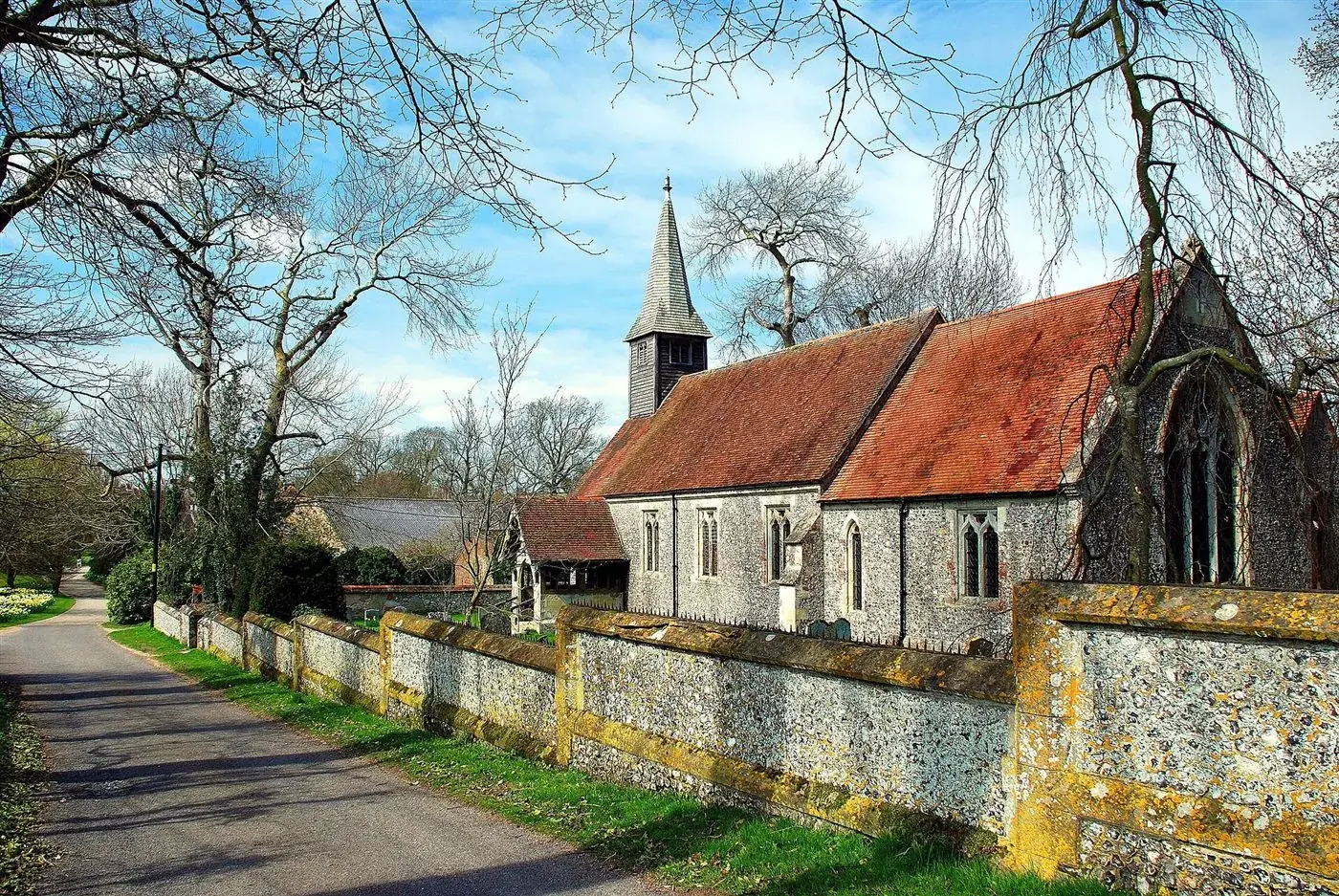
The church of Holy Trinity and St Andrew at Ashe stands on an ancient site, but most of what a visitor sees today dates from Victorian rebuilding in the late 1870s. The church Jane Austen knew has largely gone, so do not arrive expecting a Georgian interior.
Memorials from the earlier church were kept, however. Published accounts describe a group of Lefroy memorial tablets inside, one of them commemorating George and Anne Lefroy, and visitors have said that some of the lettering is now hard to make out. We have not reproduced any inscriptions here: we would sooner readers looked at the stones and transcribed them themselves than relied on a version we cannot check. For exact wording, the best printed source is the Hampshire Genealogical Society's transcription of the monumental inscriptions at Ashe.
Practical information on visiting is on our Ashe page. For a wider tour of the Austen sites in the three neighbouring parishes, see the Jane Austen guide to Steventon, Ashe and Deane.
Visiting and further research
The main places in the story are a short walk or drive apart. A sensible order is:
- Steventon first. The rectory where Jane was born has gone, but the church of St Nicholas still stands; see our page on the Austen family graves at Steventon and the list of Steventon rectors.
- Then Ashe church, to look for the Lefroy memorials, bearing in mind that the building is mostly Victorian.
- Finish at Deane, another parish with close Austen connections.
These are working parish churches, and the old rectories are private houses, so please treat them accordingly. For documentary research, Jane Austen's letters (in the standard edition by Deirdre Le Faye) are the essential primary source, and the Ashe parish registers are at the Hampshire Record Office in Winchester. Our guide to tracing ancestors in North Hampshire explains how to make a start.
Frequently asked questions
Who was Madam Lefroy?
Anne Lefroy, born Anne Brydges, wife of the Reverend George Lefroy, rector of Ashe from 1783 to 1806. She wrote poetry, read widely and was a close older friend of the young Jane Austen. Locally she was known as Madam Lefroy.
How did Anne Lefroy die?
She was thrown from her horse and died on 16 December 1804. It was also Jane Austen's birthday, and Jane noted the coincidence in the poem she wrote in her memory in 1808.
Was Tom Lefroy really in love with Jane Austen?
Jane's letters of January 1796 record a lively flirtation while Tom was staying with his relations at Ashe. Neither of them had money, Tom went to London, and nothing came of it. A late family recollection has him admitting to a boyish love for her, but the evidence is slight and a good deal of the popular story has been added since.
What became of Tom Lefroy?
He married Mary Paul in 1799 and became a barrister, a Member of Parliament and a judge. He was Lord Chief Justice of Ireland from 1852 to 1866 and died in 1869, aged 93.
How were the Austens and Lefroys related?
By marriage. In 1814 Jane's niece Anna Austen, daughter of James Austen of Steventon, married Ben Lefroy, youngest son of George and Anne Lefroy. Ben later became rector of Ashe and died in 1829.
Can I see Lefroy memorials at Ashe church today?
Published accounts describe Lefroy memorial tablets inside the church, among them one to George and Anne Lefroy, kept when the church was mostly rebuilt in the late 1870s. Some of the lettering is worn. It is a parish church, so check access before you go.
Further reading on this site
- How to Trace Your Ancestors from North Waltham, Steventon, Ashe and Deane
- A Visitor's Guide to Jane Austen's Countryside: Steventon, Ashe and Deane
- How to Read a Tithe Map and Apportionment: A Steventon Example
This guide was written for the restored archive by the society's volunteers. If you can add to it or spot a mistake, please get in touch through our contacts page.