In brief
- James Austen was born at Deane on 13 February 1765 and died at Steventon on 13 December 1819.
- At Oxford he ran The Loiterer, a weekly paper of sixty numbers begun in January 1789.
- He was curate of Deane from 1792, took over Steventon in 1801 and was rector from 1805 until his death.
- His children Anna, James Edward and Caroline all left written recollections of the family.
- He is buried in Steventon churchyard, with memorial tablets inside the church.
Contents
The eldest brother
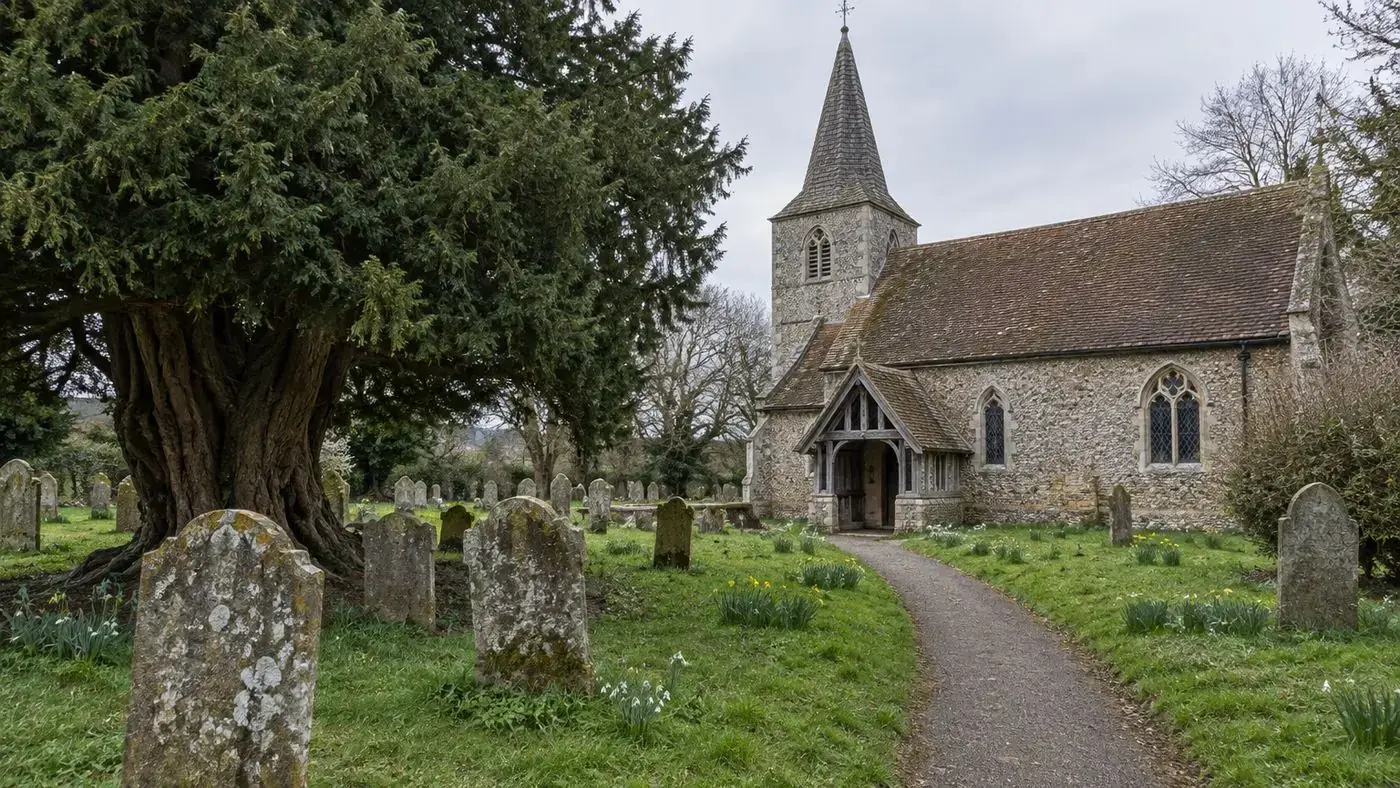
James Austen was the first child of George and Cassandra Austen, and the only one of the Austen sons to spend almost his whole life in these parishes. He was born at Deane, served as curate there, lived in Deane parsonage for most of the 1790s, and died rector of Steventon. He is buried in St Nicholas' churchyard, a few yards from the church in which he and his father between them took services for nearly sixty years.
He has tended to be written about as a minor figure beside his sister, and sometimes unkindly. The surviving record shows a hard-working clergyman, a competent and prolific writer of verse, and a man whose second marriage brought the Lloyd family permanently into the Austen circle.
At a glance
| Item | Detail |
|---|---|
| Born | 13 February 1765, Deane |
| Died | 13 December 1819, Steventon |
| Buried | St Nicholas' churchyard, Steventon; memorial tablets in the chancel |
| Posts held | Vicar of Sherborne St John; curate of Deane from 1792; curate of Steventon from 1801; rector of Steventon 1805–1819 |
| Married | Anne Mathew (died 1795); Mary Lloyd (married 1797) |
| Children | Anna (1793), James Edward (1798), Caroline (1805) |
| Traces today | Graves and tablets at Steventon; his diary and papers at Hampshire Archives |
Oxford and The Loiterer
James went up to St John's College, Oxford, his father's college. Through his mother's family, the Leighs, he qualified for a founder's-kin place, which carried free tuition and later a fellowship. His brother Henry followed him there and the two shared rooms.
On 31 January 1789 James launched The Loiterer, a weekly paper of essays in the manner of the Spectator. It ran for sixty numbers, a little over a year. James wrote most of them himself. Henry wrote nine, and a few came from Oxford friends and one correspondent whose identity is still debated. One recent writer describes the 1790s as its decade; the first issue is dated 1789 and the run finished in 1790.
The paper is worth reading for anyone interested in the family. It shows the tone of humour and the habits of reading that the younger Austens grew up with, and scholars have long looked in it for influences on Jane's early writing. How far that influence went is a matter of opinion rather than record.
Curate, husband and widower
James was ordained and in 1792 became his father's curate at Deane. He was also vicar of Sherborne St John, north of Basingstoke, a living he held until his death. Like many clergy of the period, he held more than one post and did not live in every parish he served.
In 1792 he married Anne Mathew, daughter of General Edward Mathew. They set up house in Deane parsonage, and their daughter Anna was born there in 1793. Anne died suddenly in 1795, leaving James a widower at thirty with a small child. Anna spent long periods at Steventon rectory with her grandparents and aunts.
In 1797 he married Mary Lloyd, whose family had earlier rented Deane parsonage and who was already a close friend of Cassandra and Jane. Mary's sister Martha Lloyd later lived with the Austen women at Chawton and, late in life, married Francis Austen. James and Mary's son, James Edward, was born at Deane in November 1798. Their daughter Caroline followed in 1805.
Both younger children mattered later. James Edward took the additional surname Leigh and at the end of 1869 published A Memoir of Jane Austen (the title page is dated 1870), still the starting point for most family tradition about Steventon. Caroline wrote her own reminiscences of her aunt.
Steventon, 1801–1819
When George Austen retired to Bath in 1801, James took over the duty at Steventon. Because his father kept the title of rector until he died, sources give two dates for James: 1801, when he moved into Steventon rectory and began to serve the parish, and 1805, when he became rector in his own right. Both are correct for what they describe.
He remained at Steventon for the rest of his life. The rectory he lived in was the old house in which Jane had been born; it was demolished a few years after his death. His successors are set out on our page of Steventon rectors. In short, his brother Henry followed him, and then the living went to Edward Austen Knight's son William.
James died at Steventon on 13 December 1819, aged fifty-four.
Burial and memorials
James was buried in the churchyard of St Nicholas'. His widow Mary was later buried with him. Inside the church there are memorial tablets to James, to both of his wives and to some of their relations; most descriptions place them in the chancel, though one account puts Anne's tablet on the south wall of the nave. We would welcome a member's photograph to settle the point. The graves themselves are in the north-east part of the churchyard. Our page on the Austen graves at Steventon has directions.
Writer of verse
James wrote verse throughout his life, mostly for the family rather than for print. His surviving poems include occasional pieces, religious verse and the prologues and epilogues he wrote for the plays the young Austens put on at Steventon in the 1780s. They were collected and edited by David Selwyn as The Complete Poems of James Austen, Jane Austen's Eldest Brother, published by the Jane Austen Society at Chawton in 2003.
Readers who want to judge the work for themselves have three places to start:
- Selwyn's 2003 edition, the fullest text
- Selwyn's earlier anthology, Collected Poems and Verse of the Austen Family (Carcanet, 1996), which puts James beside his relations
- Library copies of The Loiterer, several of which have been digitised
Hampshire Archives also holds a diary and correspondence of his, catalogued under his name.
Why he matters locally
For a local historian James is in some ways more useful than his father. He was in the area from birth to death, he served both Deane and Steventon, and his entries in the parish registers cover the years after the rest of the family had left. His household also links Steventon to the Lloyds, the Fowles and to the later generation who wrote down the family's memories. For his father's career see Rev George Austen.
Frequently asked questions
When did James Austen become rector of Steventon?
He took over the duty in 1801 when his father retired to Bath, but George Austen remained rector until his death. James became rector in 1805 and held the living until 1819.
Where is James Austen buried?
In the churchyard of St Nicholas', Steventon. His second wife Mary was later buried with him, and there are memorial tablets to the family inside the church.
What was The Loiterer?
A weekly paper of essays that James started at Oxford on 31 January 1789. It ran to sixty numbers, most written by James, with nine by his brother Henry.
Who were James Austen's wives?
Anne Mathew, whom he married in 1792 and who died in 1795, and Mary Lloyd, whom he married in 1797. Mary survived him.
Were James Austen's poems published?
Not in his lifetime, apart from occasional pieces. David Selwyn edited his complete poems for the Jane Austen Society in 2003.
More in People
- The Bramstons of Oakley Hall and Deane
- The Digweeds of Steventon Manor
- Edward Austen Knight (1767–1852)
- Rev George Austen (1731–1805), rector of Steventon and Deane
Written for the restored archive by the society's volunteers. Corrections and additions are welcome via our contacts page.