In brief
- Henri de Portal, a Huguenot refugee, began making paper near Whitchurch in 1711 and took Laverstoke Mill in 1718–19.
- From the 1720s, most sources say 1724, the family made the paper for Bank of England notes.
- Laverstoke House was rebuilt in the 1790s to designs by Joseph Bonomi.
- The Portals owned Ashe Park by the 1790s, and William Portal Esq held land in Steventon in 1839.
- Caroline Portal married the Rev William Knight, rector of Steventon, in 1825.
Contents
Paper-makers on the Test
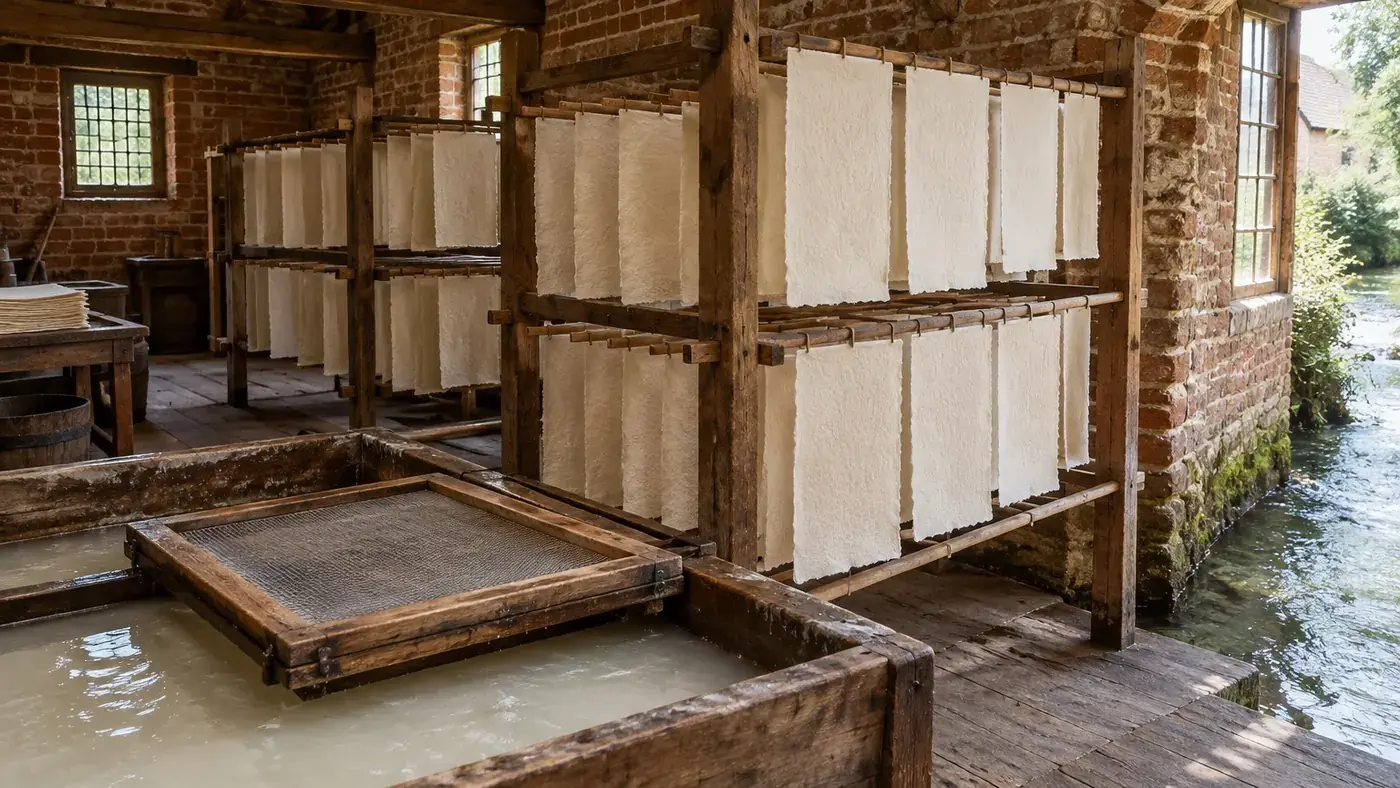
The Portals are the one family in this section whose name was known well beyond Hampshire. For more than two centuries their mills on the upper Test, at Laverstoke and later Overton, made the paper for Bank of England notes. Laverstoke lies a few miles west of our parishes, but the family's land reached further than their mills, and they turn up in the records of Ashe and Steventon as owners and as in-laws of the Austens.
At a glance
| Item | Detail |
|---|---|
| Founder | Henri (Henry) de Portal, 1690–1747, Huguenot refugee |
| Business | Paper-making from 1711; Bank of England note paper from the 1720s |
| Seats | Laverstoke House; Freefolk |
| Local land | Ashe Park (by the 1790s); land at Steventon held by William Portal Esq in 1839 |
| Austen link | Caroline Portal married the Rev William Knight, rector of Steventon, in 1825 |
| Traces today | Laverstoke Mill (now a gin distillery); Laverstoke House, seen from public roads; the Steventon tithe apportionment |
Henri de Portal and the Bank of England
Henri de Portal was born in 1690 into a Protestant family in south-west France and came to England as a child, a refugee from the persecution of the Huguenots. Accounts differ on the family's home district; Poitiers and Languedoc are both given. He worked at a paper mill at South Stoneham, near Southampton, which had been set up using Huguenot skills.
The main steps in the business, as the published histories give them, were:
- 1710: Portal took the lease of Bere Mill, near Whitchurch, with help from William Heathcote.
- 1711: he set up as a paper-maker there, was naturalised and began to call himself Henry.
- 1718–19: he took Laverstoke Mill, which was rebuilt in 1719 and became the firm's headquarters for over two hundred years.
- 1724: he won the contract to supply paper for Bank of England notes. Most sources give 1724; one gives 1727. The Governor of the Bank at the time, Sir Gilbert Heathcote, was William Heathcote's uncle, and the connection is usually thought to have helped.
Laverstoke paper became known for its watermarks, an early defence against forgery, and the Bank contract was the foundation of the family's wealth.
Laverstoke House and Freefolk
Henri's son Joseph bought the Laverstoke estate in 1759, joining the land around the mill to the park. Joseph served as High Sheriff of Hampshire. The family also bought the manor of Freefolk, next to Laverstoke, in 1769.
In the 1790s Joseph's son Henry replaced the old house at Laverstoke with a new neo-classical one designed by Joseph Bonomi the elder. Dates of 1796 and 1798 are both given; the list entry uses 1798, and the old house is said to have come down in 1796. One widely copied online account calls the architect "John Bonomi", which appears to be a slip. Laverstoke House is listed Grade II*, was extended in the mid-nineteenth century, and is privately owned and not open to the public.
The Portals' land near Steventon and Ashe
Ashe Park
By the 1790s the Portals owned Ashe Park, the large house and estate in the parish of Ashe, between Steventon and Overton. They did not live there. Lord Brabourne's 1884 notes to Jane Austen's letters say that in 1796 Ashe Park was occupied by the St John family, while the estate belonged to Mr Portal of Laverstoke. Ashe Park is a separate property from Ashe rectory, where the Lefroys lived; for the rectory family see the Lefroys of Ashe.
Steventon in 1839
The 1839 tithe apportionment for Steventon lists William Portal Esq among the landowners, alongside Edward Knight Esq, who owned most of the parish, and John Stephens Esq. The Portal holding was small by comparison with the Knights'. Exactly which William Portal is meant needs checking against family records, because the name recurs in more than one branch. The plot-by-plot detail is on our Steventon tithe map pages.
Connections with the Austens
The Portals were part of the Austens' social world rather than close friends. Brabourne's notes identify several members of the family in Jane's letters, including a Mr J. Portal of Freefolk House and a Benjamin Portal. We have not gone through every reference.
The firmest link is a marriage in the next generation. On 18 October 1825 the Rev William Knight, Edward Austen Knight's son and by then rector of Steventon, married Caroline Portal. Brabourne describes her as the eldest daughter of John Portal of Freefolk by his first marriage. She died in 1837, at the birth of their eighth child. So for twelve years the rectory at Steventon was kept by a Portal (see Edward Austen Knight for the Knight side).
Later history of the firm
- 1860: Portals won the contract for paper for the Indian rupee.
- 1880: they supplied paper for the first postal orders.
- 1901: a baronetcy was created for the head of the family.
- 1922: Overton Mill opened.
- 1963: paper-making ended at Laverstoke and moved to Overton.
- 1995: De La Rue bought Portals, and the name went out of use.
- 2014: the Bombay Sapphire gin distillery opened in the old Laverstoke Mill buildings, late in the year.
- 2018: De La Rue sold its paper business and Portals became independent again.
- 2022: the closure of Overton Mill was announced in July.
Some of the old mill buildings at Laverstoke are listed, including the former wheel house and glazing house, and stand within the distillery site.
For researchers
Portal family and estate records are scattered between record offices, and we have not attempted a list here. For the Austen connections, Le Faye's edition of the letters is more reliable than Brabourne's notes. For local land, the tithe apportionments for Steventon, Ashe and the neighbouring parishes are the best single source for who owned what in about 1840.
Frequently asked questions
Who founded the Portal paper business?
Henri (later Henry) de Portal, a Huguenot refugee born in 1690, who leased Bere Mill near Whitchurch in 1710 and was making paper there from 1711.
When did the Portals start making Bank of England paper?
Most sources give 1724. One gives 1727. Laverstoke Mill remained the centre of the work until paper-making moved to Overton in 1963.
Can I visit Laverstoke Mill?
The old mill buildings are now the Bombay Sapphire distillery, which opened in late 2014 and takes visitors. Laverstoke House is private and not open.
What was the Portals' connection with Steventon?
William Portal Esq is listed as a landowner in the 1839 Steventon tithe apportionment, and Caroline Portal married the rector, Rev William Knight, in 1825.
Did the Portals live at Ashe Park?
Not in the 1790s. Brabourne says that in 1796 the house was occupied by the St John family, although the estate belonged to Mr Portal of Laverstoke.
More in People
- The Bramstons of Oakley Hall and Deane
- The Digweeds of Steventon Manor
- Edward Austen Knight (1767–1852)
- Rev George Austen (1731–1805), rector of Steventon and Deane
Written for the restored archive by the society's volunteers. Corrections and additions are welcome via our contacts page.