In brief
- Most early documents from our parishes are written in secretary hand, which gave way to italic and then round hand during the seventeenth and eighteenth centuries.
- A handful of letters cause most of the difficulty: secretary e, h, c and r, the long s, and runs of identical strokes in m, n, u and i.
- The "ye" in "ye olde" is "the": the y stands for the old letter thorn, pronounced th.
- Abbreviations follow patterns, and a line or loop above a word nearly always means letters have been left out.
- Parish register entries before 1733 are often in simple, formulaic Latin, and a short word list covers most of it.
Contents
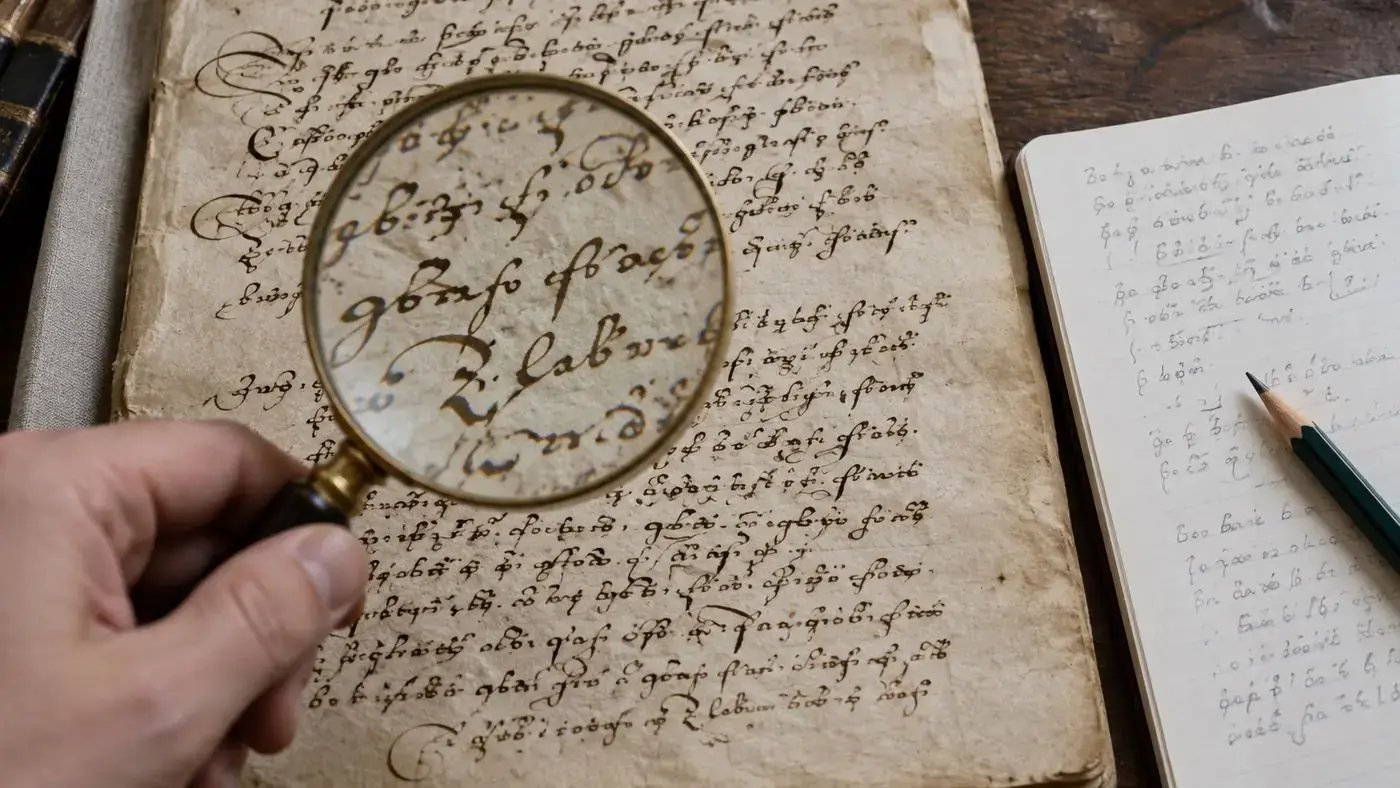
The first time you open a sixteenth-century register or will, the handwriting can look like another language. It is not. With a little practice most of it becomes readable, and the satisfaction of making out a name that nobody has read for four hundred years is considerable. Palaeography, the study of old handwriting, sounds forbidding, but for local history it mostly comes down to learning a few dozen letter shapes and abbreviations, and then reading slowly.
The main hands
Handwriting in England changed gradually, and an individual clerk might use features of more than one style. As a rough guide:
| Hand | Roughly when | What to expect |
|---|---|---|
| Secretary | Early sixteenth to mid seventeenth century | Angular, with many unfamiliar letter shapes; the main hurdle for beginners |
| Italic | From the mid sixteenth century, increasingly common after 1600 | Close to modern handwriting; often used for names and headings within secretary text |
| Mixed hands | Seventeenth century | Secretary and italic forms side by side, sometimes in the same word |
| Round hand | Late seventeenth century onwards | Flowing and regular; most eighteenth-century registers and wills |
Legal documents kept some archaic styles for longer, and a country curate writing in a hurry in 1640 can be harder to read than a scrivener of 1580. Date is a guide, not a rule.
Letters that cause trouble
Most of the difficulty in secretary hand comes from a small number of letters. Learn these and the rest follows.
- e often looks like a reversed or backward-leaning modern e, or like a small o with a stroke through it.
- h has a long tail that drops below the line and curls back, and can be mistaken for a y or a z.
- c resembles a modern r, and the secretary r can look like a w or a v. So "certain" may appear to begin with an r.
- s has several forms. The long s, like an f without the full crossbar, was used at the start and in the middle of words, and a short, sometimes loop-like s at the end. Long s continued in print until about 1800, so "Steventon" can appear as what looks like "Fteventon" in an old index.
- i, m, n and u are all built from the same short downstrokes, called minims. A word such as "minimum" becomes a row of identical strokes, and you have to count them. The i was often not dotted.
- u and v were interchangeable, with v usually at the start of a word and u in the middle: "vnto" for "unto", "haue" for "have".
- i and j were also interchangeable, and a final i in Roman numerals is usually written as j: "xiiij" is fourteen.
- ff at the start of a word stands for a capital F, so "ffrancis" is simply Francis.
Thorn and "ye"
The old English letter thorn, þ, stood for the sound th. As it became cramped in handwriting it came to look very like a y, and scribes and printers wrote "ye" for "the" and "yt" for "that", usually with the second letter raised above the line. It was always pronounced "the". "Ye olde tea shoppe" is a later joke on a misreading.
Abbreviations
Writing materials were expensive and clerks were busy, so words were shortened constantly. There are three main methods: leaving off the end of a word (suspension), leaving out letters from the middle (contraction), and raising the last letters above the line. A horizontal stroke or loop over a word is the commonest sign that something has been omitted, often an m or n.
| As written | Meaning |
|---|---|
| Wm, Willm | William |
| Jno, Jn | John (Jno is never Jonathan) |
| Jas | James |
| Thos | Thomas |
| Richd, Ric | Richard |
| Xpofer, Xtopher | Christopher (from the Greek letters chi and rho) |
| p with a stroke through the stem | per or par, as in "pish" for parish |
| p with a loop to the left | pro, as in "pved" for proved |
| wch, wth, yr | which, with, your |
| &c | etcetera |
| Ditto, do | the same as above |
When in doubt, write out the word you are sure of and put the expanded letters in square brackets: "p[ar]ish", "W[illia]m". That way you record both what the clerk wrote and how you read it.
Latin in parish registers
Many registers were kept partly or wholly in Latin until the early eighteenth century. English became compulsory in legal records from 25 March 1733, and although that law dealt with the courts, most clergy who had still been using Latin dropped it at about the same time. The Latin in a register is almost always formulaic, and you do not need to know the grammar to read it.
| Latin | English |
|---|---|
| baptizatus / baptizata fuit | was baptised (male / female) |
| sepultus / sepulta | buried (male / female) |
| nupti fuerunt, matrimonio coniuncti | were married |
| filius / filia | son / daughter |
| uxor | wife |
| vidua / viduus | widow / widower |
| spurius, illegitimus, filius populi | illegitimate |
| de hac parochia | of this parish |
| Johannes, Gulielmus, Jacobus, Henricus | John, William, James, Henry |
| Johanna | Joan or Jane |
Names were Latinised and change their endings according to grammar: "Johannes filius Johannis Smyth" is John son of John Smyth. Month names are recognisable, though often in an inflected form such as Januarii or Martii, and dates can be written in Roman numerals. Before 1752 the year began on 25 March, which our guide to Old Style and New Style dates explains. Words that turn up in English entries, such as relict, base-born and pauper, are in our old parish records glossary.
How to practise
Reading old handwriting is a skill, and like most skills it improves with regular short sessions rather than occasional marathons. Some suggestions:
- Start with a document whose content you can partly guess, such as a register entry for a family you already know from later records, or a will once you know its standard structure.
- Make an alphabet. Find every letter you can read with confidence in the document and copy it out, then use your alphabet to tackle the doubtful words.
- Transcribe line by line, keeping the original spelling and line breaks. Mark doubtful readings with a question mark in square brackets.
- Read aloud. Spelling was phonetic and inconsistent, and a word that looks meaningless often makes sense when spoken.
- Leave a hard word and come back to it. The same word will usually appear again more clearly a few lines on.
There are good free tutorials online. The National Archives has a palaeography tutorial covering documents from 1500 to 1800, worked through in order of difficulty, and a separate beginners' Latin course. The University of Cambridge's English Handwriting 1500 to 1700 course is another excellent free resource, with many sample documents. Wills are particularly good practice material, because they follow a predictable pattern; our guide to wills and probate records explains where to find them.
Finally, ask. Society members have read a good many local documents between them, and a second pair of eyes on a difficult word is often all it takes.
Frequently asked questions
Why does ye mean the?
The y in ye is not a y at all but a debased form of the Old English letter thorn, which stood for th. Writers continued to use it in abbreviations such as ye and yt long after the letter itself had fallen out of use, but it was always pronounced the.
Is that letter an f or an s?
If it lacks a full crossbar through the stem, it is almost certainly a long s, used at the beginning and in the middle of words until about 1800 in print and somewhat later in some handwriting. Reading the word aloud with an s usually settles it.
Do I need to learn Latin to read parish registers?
Not in any formal sense. Register entries before 1733 are short and formulaic, and a word list of thirty or so terms and the Latin forms of common Christian names will cover most of what you find.
Where can I learn palaeography free?
The National Archives offers a free online palaeography tutorial for documents from 1500 to 1800 and a beginners' Latin course. The University of Cambridge's English Handwriting 1500 to 1700 course is also free online.
How should I transcribe a word I cannot read?
Keep the original spelling, put any letters you have supplied in square brackets, and mark doubtful readings with a question mark, for example W[illia]m Sm[ith?]. Never guess silently.
More in Research
- Using old maps for local history
- Old money, weights and measures in local records
- Using old local newspapers for family history
- Old Style and New Style dates
Written for the restored archive by the society's volunteers. Corrections and additions are welcome via our contacts page.
You may also like
- Village trades and crafts: blacksmiths, carriers and the village shop
- Using the Census to Study a Village, 1841–1921
- How to Trace Your Ancestors from North Waltham, Steventon, Ashe and Deane
- The Poor Law in Our Villages: From Parish Overseers to Basingstoke Workhouse
- Pastimes of the Village Pub: Traditional Games in Rural Hampshire