Articles · Village history
Village trades and crafts: blacksmiths, carriers and the village shop
In brief
- Smiths, wheelwrights, carriers, thatchers, shopkeepers and publicans served every farming parish and are often easier to trace than labourers.
- The carrier's cart linked villages to Basingstoke, whose market was held on Wednesdays; check Kelly's carriers' lists for our villages' days.
- Census returns, trade directories and parish registers used together show who held each trade and for how long.
- Many tradesmen combined two or more trades, so occupations in the records can shift between entries.
- Motor transport and tractors ended most of these trades in the twentieth century; local closure dates still need establishing.
Contents
A Hampshire village of the 1850s was not simply a cluster of farm labourers' cottages around a church and a big house. It also had to shoe its horses, mend its wagons, roof its houses, sell its tea and candles, and get its eggs and butter to market. The people who did that work show up again and again in the records, and they are often easier to trace than the labourers, because they appear in trade directories as well as in the census. This article describes the trades you are most likely to find in North Waltham, Steventon, Ashe and Deane, and the sources that will tell you who followed them. The society's files contain scattered notes on individual tradesmen, but no complete list, so we have not named people here. The sources below will let you build that list for yourself.
The blacksmith and the farrier
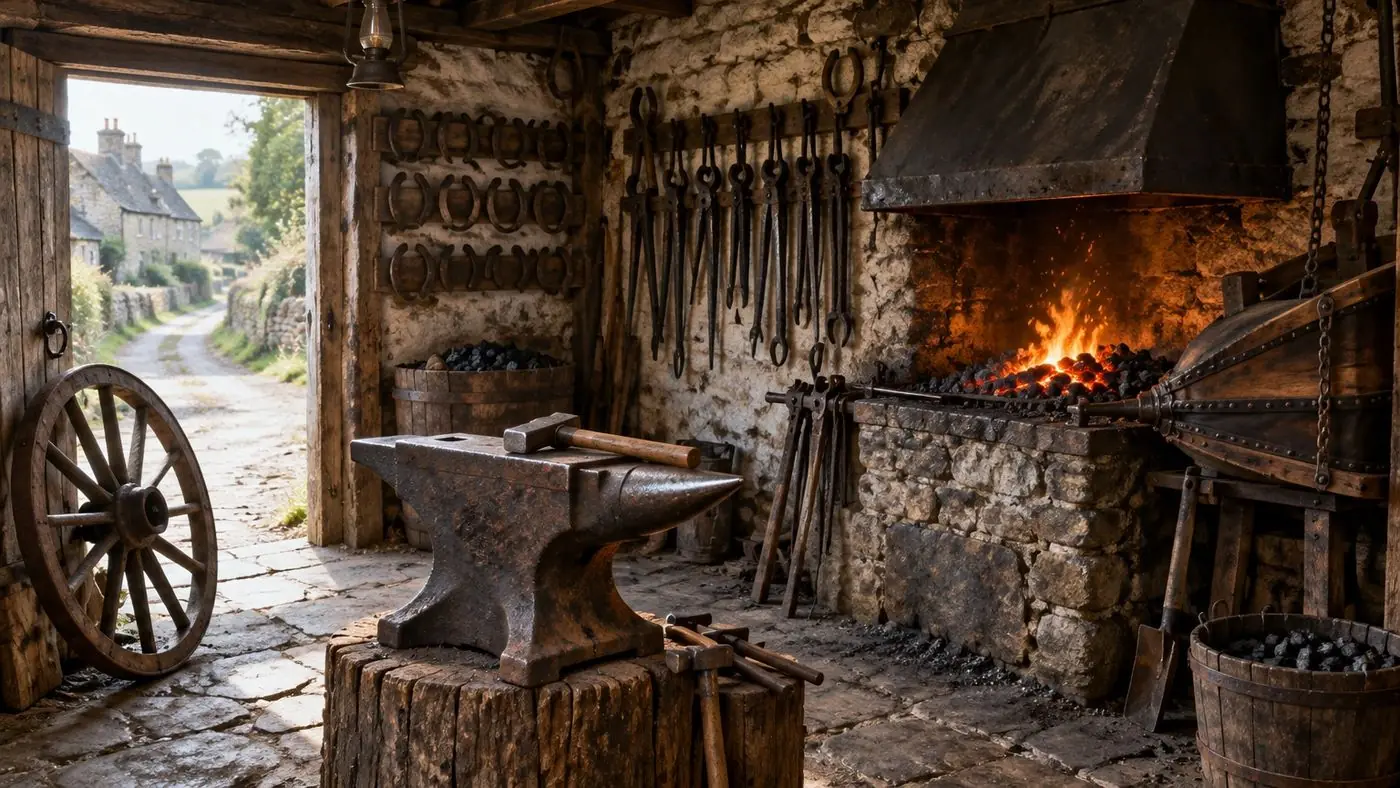
In a farming parish the forge was close to indispensable. The smith made and repaired ploughshares, harrow tines, chains, hinges, gate fittings and tools, and in many villages he also shod horses. Strictly a farrier is a shoeing smith, and a man who also treated horses' ailments, while a blacksmith works iron more generally. In practice the census enumerator wrote down whatever the householder told him, so you will find "blacksmith", "smith", "farrier", "shoeing smith" and "blacksmith and farrier" used for much the same work.
The trade often ran in families, with sons following fathers at the same forge for two or three generations. If you find a smith in one census, it is worth looking in the same household ten years earlier and later for a son described as "apprentice" or "journeyman blacksmith". Forges also tended to stay on the same site for a long time, close to a road junction or the village pub, and a building known locally as the old forge is a good clue even if no one living remembers it working. Our North Waltham buildings page is the place to check whether a particular house is recorded with that use.
Wheelwright, carpenter and thatcher
The wheelwright made and repaired carts, wagons and wheels. It was skilled work, combining carpentry with the heating and shrinking of iron tyres on to the wooden wheel, a job that usually needed the smith's help or a forge of the wheelwright's own. Many wheelwrights also worked as general carpenters, coffin makers and undertakers, because they had the timber, the tools and the skill. In a small parish one man might be described in successive censuses as wheelwright, carpenter and builder.
Carpenters and joiners did house work, barn repairs, gates and fencing. Sawyers, who cut timber over a saw pit, appear in earlier censuses and become rarer as steam-powered sawmills took over.
Thatchers were essential in a district where many cottages and farm buildings were roofed with straw. On the chalk, the usual material was long straw or wheat reed from the local harvest. A thatcher's work was seasonal and he might travel round several parishes, so do not be surprised if a known thatcher is missing from your village in one census and turns up in the next parish.
The carrier and the road to Basingstoke
Before motor transport, most country people did not own a horse and trap, and the railway station might be several miles away. The carrier filled the gap. He ran a covered cart, usually drawn by one horse, between the village and the market town on fixed days of the week, taking passengers, parcels and produce in, and bringing back shopping and orders. Victoria County History work on Basingstoke describes carriers' services centred on the town and reaching villages within six to eight miles, and directories of the period list carriers leaving Basingstoke inns for Overton, Kingsclere, Whitchurch, Odiham and many smaller places.
Basingstoke's market had been held on a Wednesday since the thirteenth century, and the 1868 National Gazetteer gives Wednesday for the corn market and Saturday for provisions. A carrier from one of our villages would therefore very likely have run on one or both of those days, but we have not found a directory entry that confirms the days for North Waltham, Steventon, Ashe or Deane specifically. The carriers' lists printed at the end of each town entry in Kelly's directories are where to check. Our article on turnpike roads and coaching inns around Basingstoke covers the roads the carts used.
The shopkeeper and the publican
The village shop, sometimes combined with the post office, sold groceries, drapery, paraffin and whatever else could not be grown or made at home. The shopkeeper was often a woman, a widow or a tradesman's wife running the shop alongside her husband's business. Look for "grocer", "shopkeeper", "general dealer", "baker" and "postmistress" in the census, and for "shopkeepers" or "beer retailers" in a directory.
The publican kept the inn or beer house. After the Beerhouse Act of 1830, any ratepayer could sell beer from their own house on payment of a modest excise fee, and many beer houses were run as a side line by a smith, a carpenter or a shopkeeper. Directories distinguish fully licensed inns from beer retailers. Licensed victuallers' recognisances, kept with the quarter sessions records, can name the licensee of an inn year by year.
Other trades worth looking for
- Shoemaker or cordwainer, and the cobbler who repaired shoes.
- Tailor, dressmaker and laundress.
- Miller, where a parish had a windmill or watermill, and the baker who used his flour.
- Hurdle maker, a common woodland craft in Hampshire, using hazel from coppice.
- Bricklayer, mason and plumber-glazier, often combined in one man.
- Higgler or dealer, who bought eggs, poultry and small produce from cottagers for resale.
How to trace village tradesmen
Three kinds of source do most of the work, and they are strongest when used together.
| Source | Dates | What it gives you | Watch out for |
|---|---|---|---|
| Census returns | 1841 to 1921 (open to the public) | Every household, with each person's occupation; from 1851, relationship and birthplace | 1841 occupations are brief and ages rounded; dual trades often reduced to one |
| Trade directories (Pigot, Post Office, White's, Kelly's) | From the 1820s to the 1930s | Principal residents and tradespeople, carriers, inns, sometimes a short history of the parish | Compiled from returns that could be a year or two out of date; labourers omitted |
| Parish registers | Baptisms with father's occupation from 1813; marriages with occupations from 1837 | Occupation at the date of a family event, linking generations | Clergy recorded occupations inconsistently |
| Quarter sessions and estate records | Varies | Licensing, leases of forges and shops, rentals | Need searching by parish in archive catalogues |
Census occupations
Start with the census, because it covers everyone. Go through each census for the parish in order and note every household head whose occupation is not agricultural. You will quickly see which trades were present and whether the same families held them. Our guide to census records for village history explains how to find and read the returns. Bear in mind that a wife who helped in the shop or a son who worked at the forge may be described as having no occupation, or simply as "son".
Trade directories
For Hampshire the main series are Pigot's directories of the 1820s and 1830s, the Post Office directories from the 1840s and 1850s, White's History, Gazetteer and Directory of Hampshire and the Isle of Wight of 1859 and 1878, and Kelly's directories, which appeared at intervals of a few years from the later nineteenth century until shortly before the Second World War. Exact years vary between published lists, so check which editions your library holds. Each village entry usually opens with a description of the parish, the church and the main landowners, then lists private residents and commercial entries in alphabetical order. A run of directories lets you see a business appear, change hands and disappear. Many editions have been digitised and are free to search online through university and family history collections, and Hampshire libraries hold printed copies.
Parish records and other sources
Baptism registers after 1813 give the father's occupation, which can date a man's arrival in a trade more closely than the ten-yearly census. Wills and probate inventories, especially before the nineteenth century, can list a smith's anvil and bellows or a wheelwright's stock of timber; our page on wills and probate records explains how to find them. Local newspapers carried notices of sales of a deceased tradesman's stock and tools.
Decline with motor transport
Most of these trades shrank in the first half of the twentieth century. The pattern was broadly similar across rural southern England, though the timing varied from parish to parish:
- Motor buses from the 1920s took over the carrier's passengers, and motor lorries his goods. Some carriers bought a motor van and carried on for a while.
- Tractors replaced farm horses, slowly between the wars and much faster after 1945, removing most of the shoeing and much of the wheelwright's work. Some smiths turned to agricultural engineering or became garages.
- Factory-made boots, clothes and goods ended the village shoemaker and tailor.
- Better roads made a trip to Basingstoke shops easy, leaving the village shop to compete on convenience.
We do not have firm dates for when the last forge, carrier or shop closed in any of our four parishes. Kelly's directories of the 1920s and 1930s, read against the 1921 census and the 1939 Register, are the best way to establish them, and older residents' memories, where recorded, fill in the rest. If you hold photographs or recollections of a village tradesman, the archive would very much like to hear about them.
Frequently asked questions
What is the difference between a blacksmith and a farrier?
A farrier shoes horses and traditionally treated their ailments; a blacksmith works iron generally. In a village one man usually did both, and census entries use the terms loosely.
Which trade directories cover north Hampshire?
Pigot's directories of the 1820s and 1830s, the Post Office directories, White's directory of Hampshire and the Isle of Wight (1859 and 1878), and Kelly's directories from the later nineteenth century to the late 1930s.
Did our villages have a carrier to Basingstoke?
It is very likely, since carriers served villages within six to eight miles of the town, but we have not yet confirmed named carriers or their days for North Waltham, Steventon, Ashe or Deane. The carriers' lists in Kelly's directories are the place to check.
Why can't I find a tradesman in a directory although he is in the census?
Directories listed people who paid to appear or who were thought important, and they were often compiled a year or more before publication. Small or short-lived businesses can be missing.
How can I find out when the village forge closed?
Work through Kelly's directories edition by edition until the smith disappears, then check the 1921 census and the 1939 Register. Local memories and photographs, where recorded, help pin the date down.
Are parish registers useful for occupations?
Yes. Baptism registers from 1813 give the father's occupation, and marriage registers from 1837 give the occupations of the groom and both fathers.
Further reading on this site
- Pastimes of the Village Pub: Traditional Games in Rural Hampshire
- Victorian Village Schools in Rural Hampshire
- The Farming Year in a Chalk Downland Parish
This guide was written for the restored archive by the society's volunteers. If you can add to it or spot a mistake, please get in touch through our contacts page.
You may also like
- The Poor Law in Our Villages: From Parish Overseers to Basingstoke Workhouse
- The Steventon Tithe Map, 1839
- Nonconformist chapels and meeting houses in rural Hampshire
- A Visitor's Guide to Jane Austen's Countryside: Steventon, Ashe and Deane
- How to Make a “Then and Now” Photographic Record of Your Village