In brief
- Censuses survive for 1841 to 1921; the 1931 returns were destroyed and no census was taken in 1941.
- The 1841 census rounds adult ages down and gives no relationships; from 1851 there is much more detail.
- Enumerators walked a set route, so their returns can be mapped house by house.
- Use the census together with tithe apportionments, parish registers and directories.
- The 1939 Register covers the gap until the 1951 census opens under the 100-year rule.
Contents
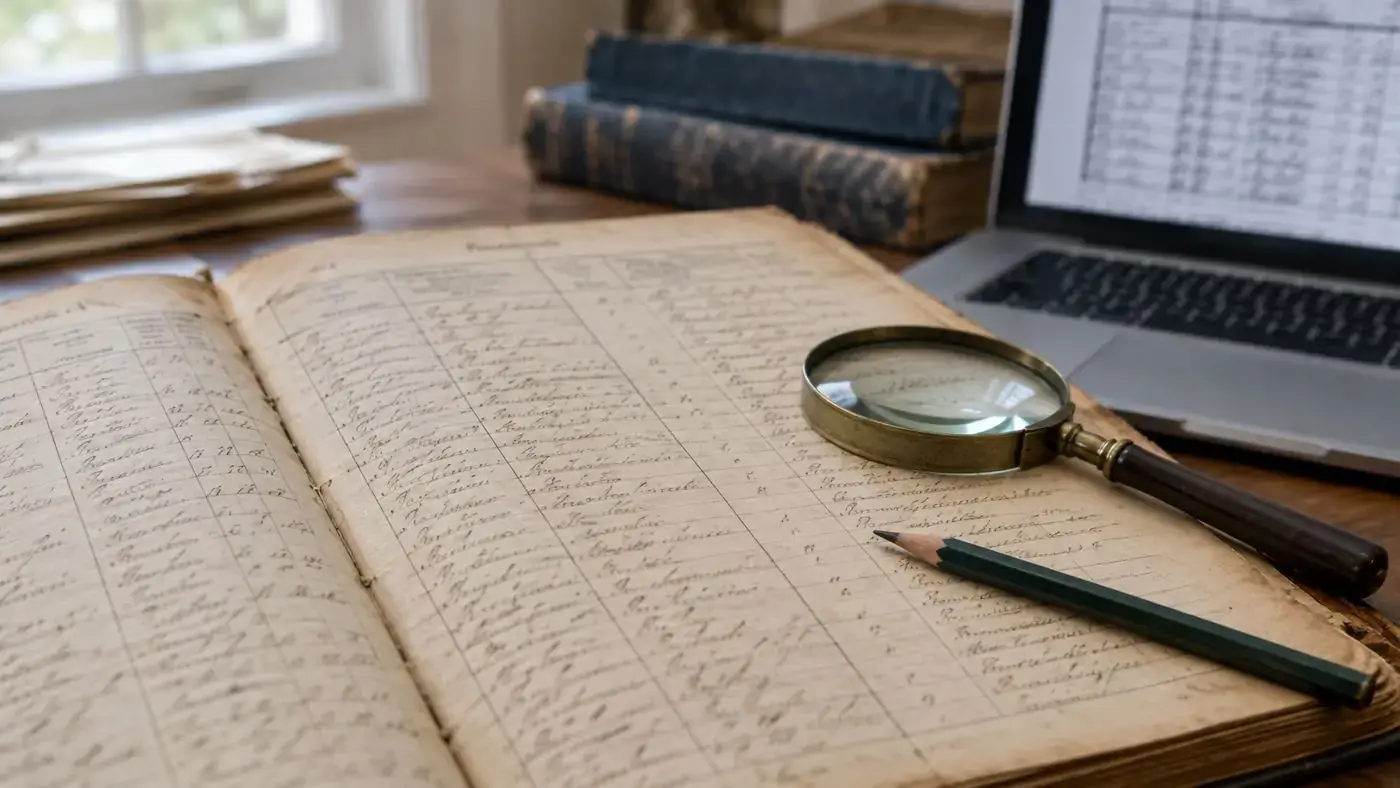
Every ten years from 1841 to 1921, census enumerators went round the lanes of Hampshire parishes, calling at cottages, farmhouses and the rectory to take down the name of everyone who slept there on census night. Put together, their returns are about as close as we can get to a moving picture of village life over eighty years. Family historians mostly use the census to find a single household. Here we look at using it for something bigger: a study of a whole village, such as North Waltham or Steventon, house by house and decade by decade.
How the census was taken
National censuses began in 1801, but before 1841 the returns were mainly head counts, and only odd local lists of names survive. From 1841 the work was organised through the civil registration districts. Each district was split into enumeration districts small enough for one person to cover in a day or so. A rural parish might make up one enumeration district on its own or be put together with a neighbour.
Householders' schedules and enumerators' books
From 1841 a schedule was left at each household to be filled in for census night. The enumerator collected the schedules, helped those who could not write, and copied the details into his enumeration book. For 1841 to 1901 it is these books that survive, not the original schedules, and they are what you see online. This matters, because every entry has been through a second pair of hands, with all the scope that gives for misheard names, guessed ages and copying slips. For 1911 and 1921 the householders' own schedules were kept, so you can often see a family's own handwriting.
The front pages
Do not skip the first pages of each enumeration book. They set out the boundaries of the district and often name farms, hamlets and roads in the order the enumerator walked them. For a village study that description works as a route map, and it helps in working out where outlying cottages actually stood.
What each census asks
| Year | Census night | Key features and differences |
|---|---|---|
| 1841 | 6 June | Names, sex, age (adults usually rounded down to the nearest five), occupation; birthplace only as "same county" yes or no, or Scotland, Ireland or foreign parts. No relationships or marital status. |
| 1851 | 30 March | Adds relationship to head, marital condition, exact age, parish and county of birth, and disabilities such as blindness or deafness. The first fully useful census for families. |
| 1861 | 7 April | Much as 1851. |
| 1871 | 2 April | Much as 1851, with more detail on mental illness and disability. |
| 1881 | 3 April | Much as 1871. Fully indexed and free on several sites, ideal for a first village survey. |
| 1891 | 5 April | Adds whether employer, employed or neither, and number of rooms if fewer than five. |
| 1901 | 31 March | Adds whether working at home; employment status retained. |
| 1911 | 2 April | Householder's own schedule survives. Adds years of marriage, children born alive, living and died, rooms in the dwelling, and nationality for those born abroad. |
| 1921 | 19 June | Adds place of work and employer's name, and for children under fifteen whether parents are alive. Divorce recorded. Taken in summer, so visitors and seasonal workers distort some places. |
| 1931 | 26 April | Returns for England and Wales destroyed by fire in 1942. Nothing survives for individuals. |
| 1941 | Not taken | No census in wartime; the 1939 Register partly fills the gap. |
The 1841 rounding of ages
In 1841 enumerators were told to round down the ages of everyone over fifteen to the nearest five, so a person of 38 should appear as 35. Not all of them did, and some put down exact ages, which means you cannot always tell which you are looking at. Treat an adult's age in 1841 as a range of up to five years and check it against a later census or a baptism.
Households and occupations
Each household starts with its head, followed by the wife, children, other relatives, lodgers and servants. In 1841 a double slash marks the end of a house and a single slash the end of a household within it, which shows where two families were sharing a cottage. From 1851 the relationship column makes this plainer.
In our villages the occupation column is mostly about farming. Among the terms you will come across:
- Agricultural labourer, or "ag lab": the largest group of men in most rural Hampshire parishes, often working for several farmers in the course of a year.
- Carter or waggoner: the man in charge of the farm horses and carts, a skilled job that paid better.
- Shepherd: an important man on the chalk downland of North Hampshire, where sheep and corn went together.
- Farmer, often with the acreage and the number of labourers employed given from 1851.
- Bailiff, dairyman, cowman, ploughman and hurdle maker.
- Village trades: blacksmith, wheelwright, carpenter, bricklayer, shoemaker, baker, publican, carrier.
- Women's work: domestic servant, laundress, dressmaker, and sometimes field work, which often went unrecorded.
Children entered as "scholar" were going to school, in principle at least. Our glossary of old parish record terms explains a good many of the less familiar words.
Reconstructing a village street by street
Because the enumerator walked a route and wrote the houses down in order, a census can be turned into a map of who lived where. One way of going about it:
- Pick an anchor year. 1881 suits well, being fully indexed and fairly consistent.
- Transcribe the parish in schedule order into a spreadsheet: schedule number, address as written, and each person's name, age, occupation and birthplace.
- Find the fixed points. The church, rectory, inns, farmhouses, school and forge rarely move and are often named.
- Follow the enumerator's route between those points, using the district description and an Ordnance Survey map of about the same date.
- Work backwards and forwards a decade at a time, matching the families who stay put and noting those who arrive, leave or move house within the parish.
- Write down your doubts. If a cottage cannot be placed with confidence, say so in your notes rather than forcing it to fit.
Across several censuses, patterns start to show: how many households were headed by labourers, how far people had come, how farm sizes changed, and how the population fell from the later nineteenth century as young people left for the towns and the railways.
Population totals and published reports
Besides the household returns, the census authorities published printed reports giving each parish's total population and number of inhabited houses, sometimes with explanatory notes. The figures go back to 1801 and are a quick way to chart a village's rise and fall before you start transcribing names. The footnotes now and then account for a sudden jump or drop, such as railway construction workers present on census night or the closing of a workhouse. Many of these tables can be consulted easily on the Vision of Britain website or at county record offices. Comparing them with your own counts from the enumerators' books is also a good check that no pages have gone missing.
Combining the census with other sources
Tithe maps and apportionments
The tithe surveys made after the Tithe Commutation Act of 1836 consist of a numbered map of the parish and an apportionment giving the owner, occupier, name and use of every plot. Many Hampshire tithe surveys date from around 1840, very close to the 1841 census, so matching occupiers in the apportionment with heads of household in 1841 can put families in particular cottages and fields. See our Steventon tithe map and our guide to reading a tithe map.
Parish registers
Registers of baptisms, marriages and burials fill the gaps between censuses and confirm ages and relationships. They also show the children born and buried within one decade who never appear in a census at all. Our guide to tracing ancestors in North Hampshire says where the registers are held.
Directories, rate books and electoral registers
Trade directories name the farmers, tradesmen and principal residents. Rate books and electoral registers can show who occupied a particular property in the years between censuses.
The 1939 Register and the 100-year rule
Individual census returns for England and Wales stay closed for 100 years, which is why the 1921 census was not released until January 2022. As the 1931 returns were destroyed and no census was taken in 1941, the next one to open will be 1951, in the early 2050s.
In the meantime the best substitute is the 1939 Register, taken on 29 September 1939 to issue identity cards and plan for war. For each address it gives every person's name, exact date of birth, marital status and occupation. Entries for people who may still be alive are closed unless the person is known to have died, so you will see some lines blacked out. The Register is online through the main family history websites.
Pitfalls to watch for
- Indexing errors. Search under variant spellings, and for a small parish simply browse page by page.
- Birthplaces that change. A person may give a different parish each decade, or just name the nearest town.
- Ages that drift. A year or two either way between censuses is common.
- People who are missing. Anyone away on census night, at sea, in service elsewhere or in the workhouse will be recorded somewhere else.
- Boundary changes. Parishes and enumeration districts were sometimes redrawn, and outlying farms may turn up in a neighbouring book.
Frequently asked questions
Which census is best to start a village study with?
1881 is a good place to start. It is fully indexed, free on several websites, and gives relationships, exact ages and birthplaces. Work backwards and forwards from there.
Why are ages in the 1841 census often wrong?
Enumerators were told to round the ages of people over fifteen down to the nearest five, though they did not all do it consistently. Treat adult ages in 1841 as approximate.
Why can I not find the 1931 census?
The 1931 returns for England and Wales were destroyed by fire in 1942, and there was no census in 1941. For that period the 1939 Register is the main substitute.
When will the 1951 census be released?
Census returns are closed for 100 years, so the 1951 census should become available in the early 2050s.
How can I tell which house a family lived in?
Follow the enumerator's route as described at the front of the book, pick out fixed points such as farms, the church and the inns, and compare with a tithe map and Ordnance Survey maps of about the same date.
Does the census show what people actually did for a living?
It shows what people, or the householder, told the enumerator. Women's part-time and seasonal work was often left out, and a labourer's many different jobs were summed up as agricultural labourer.
Further reading on this site
- How to Trace Your Ancestors from North Waltham, Steventon, Ashe and Deane
- How to Read a Tithe Map and Apportionment: A Steventon Example
- Turnpike Roads and Coaching Inns Around Basingstoke
This guide was written for the restored archive by the society's volunteers. If you can add to it or spot a mistake, please get in touch through our contacts page.