In brief
- Chalk downland parishes used the sheep-and-corn system, with folded flocks manuring thin arable soils.
- Farmers on the chalk adapted the Norfolk four-course rotation of wheat, turnips, barley and clover.
- Steventon's tithe apportionment of about 1839 shows a mainly arable parish with some woodland and little pasture.
- Threshing machines threatened winter work and helped set off the Swing Riots, which reached Hampshire in November 1830.
- Michaelmas and Lady Day marked the farming calendar for tenancies, rents and hiring.
Contents
North Waltham, Steventon, Ashe and Deane lie on the chalk of the Hampshire Downs: thin, flinty soils, wide rolling fields and very few streams. For centuries nearly everyone in these parishes made a living from the land, and the farming year settled work, wages and holidays, and even when people married or moved house. This article describes that year as it went in a typical chalk downland parish in the late eighteenth and nineteenth centuries. It deals with the general pattern rather than the history of any one farm, and points to the local documents, the tithe apportionment above all, that let you test the general picture against your own village.
Sheep and corn: the chalkland system
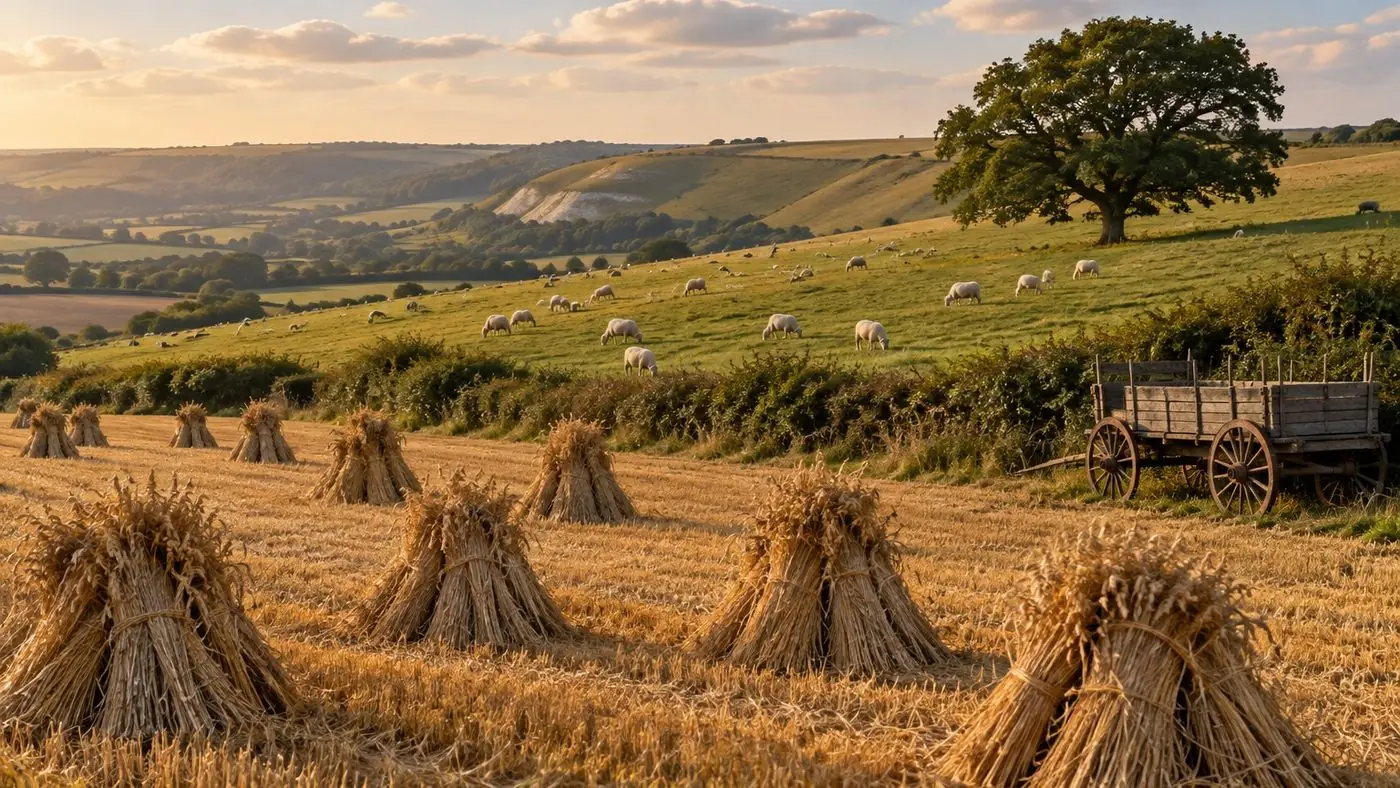
Chalk soils are light, drain quickly and are naturally poor. Left alone they grow short downland turf, good for sheep and not much use for crops. The solution, worked out over many generations, was the sheep-and-corn system, in which the two depended on each other.
Big flocks grazed the open downs by day and at night were folded on the arable, penned inside hurdles that the shepherd moved on a little each day. The sheep trod and dunged the ground, and on these hungry soils that was the most valuable thing they did; hence the old name for the flock, the "golden hoof". Wool and mutton had their uses, but to many farmers the sheep were first and foremost a way of growing corn.
Where a parish had a river, as along parts of the Test and its tributaries, water meadows could give ewes and lambs an early bite of grass in spring. Upland parishes without them leaned more on fodder crops.
The four-course rotation on chalk
From the later eighteenth century, improving farmers across southern England took up versions of the Norfolk four-course rotation. In its textbook form a field carried, in successive years:
- Wheat, the main cash crop;
- Turnips or swedes, a root crop eaten off by the folded sheep;
- Barley, often undersown with grass and clover seed;
- Clover or "seeds", cut for hay or grazed, which also put nitrogen back into the soil.
On the chalk the scheme was adapted, not copied. Rotations were often longer, the "seeds" might stay down for two years, and vetches, rape or sainfoin were grown for extra fodder. Oats took the place of barley on the poorer fields. The principle stayed the same: fodder fed the sheep, the sheep manured the land, and the land then grew corn.
What the tithe map tells us
For many Hampshire parishes the best single picture of land use is the tithe apportionment made after the Tithe Commutation Act of 1836, which replaced tithes paid in kind with a rent charge. The apportionment lists every parcel of land with its owner, occupier, acreage and state of cultivation, usually arable, meadow, pasture or wood.
The Steventon apportionment, of about 1839, describes a parish that was overwhelmingly arable, with some woodland and very little permanent pasture. That is what the sheep-and-corn system would lead you to expect, since the sheep were fed on fodder crops grown in rotation on the arable and not on large areas of grass. The details are on our Steventon tithe map page, and our guide to reading a tithe map explains how to read the schedules for any parish.
Through the year
Autumn: ploughing and sowing
The farming year was often counted from Michaelmas, 29 September, when many tenancies changed hands and the harvest accounts were settled. Autumn meant ploughing the stubbles and sowing winter wheat. Teams of horses, or on some farms in earlier times oxen, dragged the plough through fields so full of flints that ploughshares wore out fast. Seed was sown broadcast by hand or, more and more during the nineteenth century, with a seed drill.
Winter: threshing, hedging and the flock
Winter work was hard and cold, and there was often not enough of it. The corn cut in summer stood in ricks or barns and was threshed during the winter months. Labourers also cut and laid hedges, cleared ditches, carted manure and chalk, and looked after the root crops the folded flock was eating off. The shepherd's busiest time was lambing, which on downland farms usually came in late winter.
Spring: barley, roots and lambs
In spring came the sowing of barley and oats, rolling and harrowing, and getting ground ready for turnips. Lady Day, 25 March, was another quarter day, when rents fell due and some tenancies began. Children were often kept off school to scare birds from new-sown fields or to help pick stones.
Summer: haymaking, shearing and harvest
Haymaking came in June. The clover and seeds leys, and any meadow grass, were cut with scythes, then turned, cocked and carted. Sheep-washing and shearing also belonged to early summer. The high point of the year was the corn harvest in August, which drew the whole community into the fields, women and children too. Wheat was cut with sickles or reaping hooks, later with scythes and then mechanical reapers, bound into sheaves, and stood in stooks to dry before it was carted.
Gleaning followed the harvest. The poor were let into the cleared fields to pick up fallen ears of corn, and for a labouring family a good gleaning could supply a real share of the winter's flour. The custom was widespread, but gleaning was a matter of local permission, not a legal right, and it was usually the farmer who said when it could start.
The farming year month by month
| Month | Main field work | Livestock and other tasks |
|---|---|---|
| January | Threshing; hedging and ditching | Flock folded on turnips; carting manure |
| February | Ploughing for spring crops | Lambing on many downland farms |
| March | Sowing barley and oats | Lady Day rents and tenancies (25 March) |
| April | Harrowing and rolling; sowing clover seed under barley | Bird-scaring; ewes and lambs on early grazing |
| May | Preparing turnip ground; weeding corn | Sheep-washing |
| June | Haymaking; sowing turnips | Shearing |
| July | Hoeing roots; finishing hay | Repairing carts and ricks before harvest |
| August | Corn harvest: reaping, binding, stooking, carting | Harvest supper at the end |
| September | Gleaning; ploughing stubbles | Michaelmas (29 September): tenancies, hiring and settling accounts |
| October | Sowing winter wheat | Sheep sales and fairs |
| November | Finishing wheat sowing; lifting roots | Folding begins on root crops |
| December | Threshing begins in earnest | Winter work scarce for day labourers |
Timings varied with the weather, the farm and the period, so take the table as a typical pattern and not a fixed calendar.
The farm labourer's working life
Most men in these villages were labourers, not farmers. Some, particularly skilled men such as carters and shepherds, were hired by the year and often had a cottage that went with the job. Far more were day labourers, paid by the week and liable to be laid off in bad weather or slack times. Women and children worked as well, at harvest and haymaking, stone-picking and weeding, usually for less money.
Wages in the southern counties were among the lowest in England. In the early nineteenth century a Hampshire labourer commonly earned well under ten shillings a week, and in bad years families relied on poor relief from the parish to get by. Harvest paid better, often by the piece, and those few extra weeks could decide whether the rent was paid. Our glossary of old parish records explains terms such as overseers, settlement and removal that crop up in poor law papers.
Hiring fairs and Michaelmas
In many parts of England, servants in husbandry were taken on at yearly hiring or "mop" fairs, usually around Michaelmas, where workers stood to be picked and were then bound for the year ahead. Custom differed from one district to another, and by the nineteenth century farmers in much of the south often hired their men directly. Market towns such as Basingstoke held regular fairs where livestock, produce and labour all changed hands. Either way, Michaelmas remained the hinge of the farming calendar.
From flail to threshing machine, and the Swing Riots
For centuries threshing meant beating the grain out of the straw with a flail on the barn floor and then winnowing it to get rid of the chaff. The work was slow and dusty, but it kept men employed through the winter, when there was little else.
Horse-powered threshing machines spread through southern England from the late eighteenth century. Farmers saw a saving; labourers saw the loss of the winter work their families lived on. Low wages, a harsh poor law, tithes and a run of bad harvests together brought matters to a head in 1830.
That autumn the disturbances known as the Swing Riots, named after the threatening letters signed by a fictitious "Captain Swing", spread from Kent across the southern counties. Hampshire was badly hit in November 1830, with machine-breaking, demands for higher wages and lower tithes, and some attacks on workhouses. A Special Commission sat at Winchester in December 1830 and tried around three hundred people. Many were sentenced to death, though most of the sentences were commuted, often to transportation to Australia. Henry Cook of Micheldever, not far from these parishes, was one of those hanged. Whether any of the incidents happened in North Waltham, Steventon, Ashe or Deane is a matter for the court records and newspapers of the time, and we would be glad to hear from any reader with evidence.
Later in the century, steam threshing sets travelling from farm to farm replaced both the flail and the horse machine, and the barn's winter routine was gone for good.
Researching farming in your own parish
Local sources will let you test the general picture and fill it in:
- tithe apportionments and maps (around 1838–1845), for land use, field names, owners and occupiers;
- census returns from 1841, which give occupations and, from 1851, farm acreages and the number of labourers employed;
- estate papers, leases and sale particulars, many of them at the Hampshire Record Office;
- for the twentieth century, the 1910 valuation and the 1941–43 National Farm Survey;
- poor law records and parish registers, which show how the ups and downs of farming bore on labouring families.
Our guide to tracing ancestors in North Hampshire explains where these records are kept, and the village pages for Steventon and North Waltham give local background.
Frequently asked questions
What was the sheep-and-corn system?
The traditional way of farming the chalk downs. Sheep grazed the downs by day and were folded at night on the arable, where their dung kept the thin chalk soil fertile enough for wheat and barley.
Why does the Steventon tithe map show so little pasture?
On the chalk, sheep were mostly fed on fodder crops such as turnips, clover and vetches grown in the arable rotation, not on permanent grass. The apportionment of about 1839 records a parish that was overwhelmingly arable, with woodland and little pasture.
What was gleaning?
Once the corn had been carted, poor families were allowed into the fields to pick up the fallen ears. It depended on the farmer's say-so, but it could add a useful store of flour for the winter.
Why was Michaelmas important on the farm?
Michaelmas, 29 September, marked the end of the harvest year. Many tenancies began or ended then, rents and accounts were settled, and in some districts farm servants were hired for the year at fairs held around that date.
Did the Swing Riots affect this area?
Hampshire was among the worst-affected counties in November 1830, and that December a Special Commission at Winchester tried around three hundred people. Henry Cook of nearby Micheldever was hanged. Whether there were incidents in these four parishes still needs checking in the records of the time.
How much did a farm labourer earn?
In early nineteenth-century Hampshire a labourer's weekly wage was commonly well under ten shillings, among the lowest in England. Harvest piecework brought in extra, and in hard times many families also relied on poor relief from the parish.
Further reading on this site
- Pastimes of the Village Pub: Traditional Games in Rural Hampshire
- Victorian Village Schools in Rural Hampshire
- How to Trace Your Ancestors from North Waltham, Steventon, Ashe and Deane
This guide was written for the restored archive by the society's volunteers. If you can add to it or spot a mistake, please get in touch through our contacts page.