Articles · Village history
Pastimes of the Village Pub: Traditional Games in Rural Hampshire
In brief
- Skittles, quoits, dominoes and cribbage were played in village pubs long before darts took over.
- Darts caught on fast in the early twentieth century, above all between the wars, and spread through league play.
- Village inns housed friendly societies, clubs and meetings, and the roadside inns on the turnpikes served travellers.
- A lot of local custom was never written down, which makes memories and old photographs especially valuable.
Contents
Before radio, television and the motor car, working people in rural Hampshire had few places to go of an evening apart from the pub. Besides the beer and the talk there were games. Some needed nothing more than a pack of cards or a box of dominoes; others needed a skittle alley in the yard or a quoit bed behind the stables. This article covers the games played in country pubs and the inn's other use as a meeting place. Where our own villages are concerned, we have tried to keep what is on record apart from what is only likely.
Why pub games mattered
Farm labourers, craftsmen and their families had little spare time and less spare money. A pub game cost next to nothing, let a man show his skill in front of the neighbours, and kept a team or a group of regulars together. It also gave the landlord a reason for his customers to stay and order another.
Games differed from region to region. Skittles and Aunt Sally grew strong local forms, while dominoes and cribbage were played all over the country with only small differences in the rules. What was played in any one Hampshire village pub came down to the space available, the landlord's own tastes and local habit, and it is seldom written down in any detail.
The traditional games
Skittles and ninepins
Skittles is among the oldest of English pub games. Players roll or throw a ball (in some versions a wooden disc called a cheese) at a set of pins, usually nine, standing in a diamond. The forms run from long alley skittles, common in the West Country, to table skittles, where a ball on a chain is swung round a post. The alley was often in a shed of its own or down one side of the pub yard.
Quoits
In quoits, heavy iron rings are thrown at a pin, or hob, set in a bed of clay, and points go to ringing the pin or landing nearest to it. In the nineteenth century it was played across England and Wales, with strongholds in the north and in parts of Wales and East Anglia. Indoors there was a lighter game with rope or rubber rings. Old quoit beds can sometimes still be traced in pub gardens, or older residents remember them.
Shove ha'penny
Shove ha'penny comes from the older game of shovelboard. Each player strikes coins or polished discs with the heel of the hand so that they slide up a smooth board marked across into beds. It takes up hardly any room and was a favourite in many southern English pubs. Boards were usually slate or hardwood and kept well polished.
Dominoes and cribbage
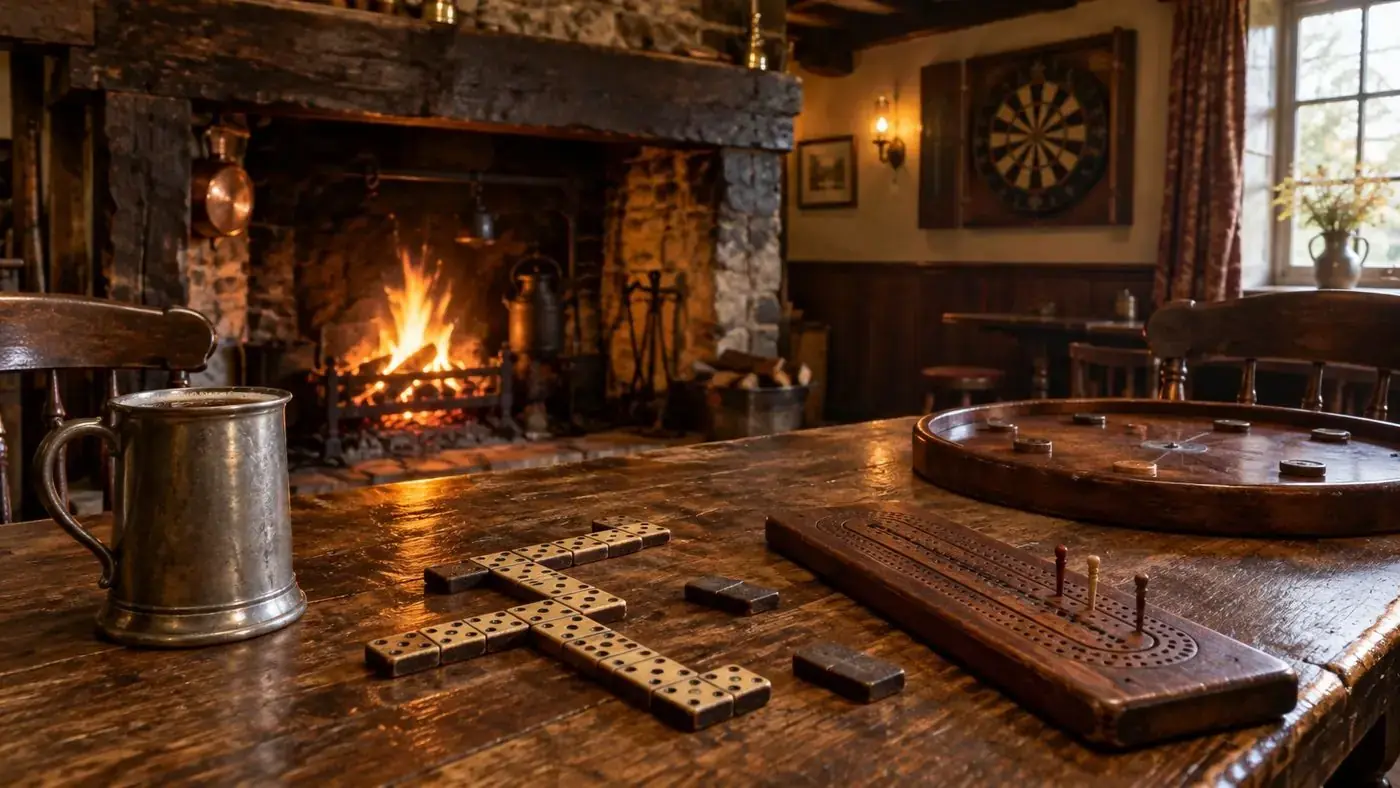
Dominoes and cribbage were probably the commonest pub games of all. Both are quiet and sociable and suit a corner table on a winter night. Cribbage is played with cards and a pegging board, and is said to have been invented in the seventeenth century by the poet Sir John Suckling, though that rests on tradition.
Darts
Darts as we know it is a fairly late arrival. The numbered board now in every pub became standard around the turn of the twentieth century, and the game took off between the wars, helped along by brewery-backed leagues and national competitions. There is an often-told story of a court case around 1908 in which darts was shown to be a game of skill and not of chance. The details are uncertain, but the story does show how much the question of skill or chance mattered when deciding which games a pub could allow. By the middle of the century the dartboard was the one thing you could expect to find in a public bar in most of England.
Bar billiards
Bar billiards is usually said to have come to England from Belgium in the 1930s. It is played on a small table with holes in the bed and mushroom-shaped pegs that must not be knocked down, and it caught on in pubs across southern England, especially in Oxfordshire, Buckinghamshire, Kent and Sussex. The name comes from the coin-operated tables, where a timer drops a bar so that the balls stop coming back.
Aunt Sally: a regional note
In Aunt Sally players throw sticks to knock a wooden "doll" off a spindle. It belongs mainly to Oxfordshire and the country round about, where there are still thriving leagues. We include it only because visitors sometimes take it for granted that it was played all over southern England. We know of no evidence that it was ever played in our parishes, and it would be unwise to assume it was.
Pub games at a glance
| Game | Origin and era | How it is played |
|---|---|---|
| Skittles / ninepins | Medieval and later; many regional forms | Roll or throw a ball or disc to knock down pins set in a diamond |
| Quoits | Widespread by the eighteenth and nineteenth centuries | Throw iron rings at a pin set in a clay bed |
| Shove ha'penny | Developed from Tudor shovelboard; popular in the nineteenth and twentieth centuries | Slide coins up a marked board into scoring beds |
| Dominoes | Known in England from the eighteenth century | Match tiles end to end; many scoring variants |
| Cribbage | Traditionally dated to the seventeenth century | Card game scored by pegging on a holed board |
| Darts | Modern board standardised c.1900; boom between the wars | Throw darts at a numbered board, usually counting down from 501 or 301 |
| Bar billiards | Introduced from Belgium in the 1930s | Cue balls into holes on a small table while avoiding pegs, against a timer |
| Aunt Sally | Nineteenth century; Oxfordshire tradition | Throw sticks to knock a "doll" off a post |
The pub as meeting place
Games were only part of it. Until village halls became common, the inn was often where people met for:
- friendly societies and benefit clubs, which took small weekly subscriptions to help members when they were ill or to pay for funerals, and often had a yearly club day with a church service, a procession and a dinner;
- parish and vestry business, sales of property and livestock, and inquests;
- sports clubs, cricket among them, and later darts and football teams;
- celebrations such as harvest suppers and coronation and jubilee festivities.
Where friendly society records survive they are in county record offices and the national archives, and they often say which pub the society met at.
Roadside and coaching inns
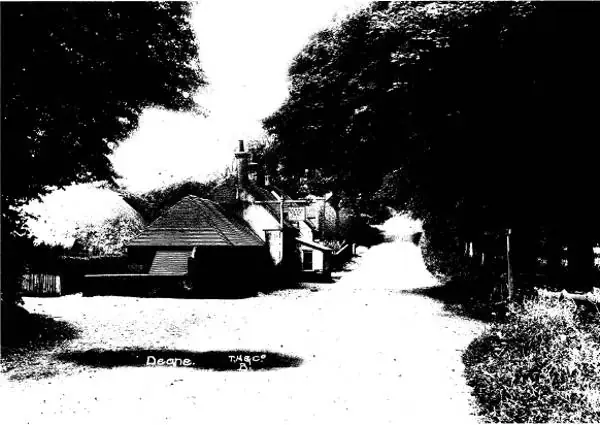
Some inns served more than their own village. On the turnpike roads out of Basingstoke there were inns for carriers, drovers and coach passengers. Our archive has an image of the Deane Gate Inn, which stood by the road west of Basingstoke near Deane and took in through traffic as well as local people. At present we have no detailed documents on its early history or on what games were played there, and we would be glad to hear from anyone who has. For the roads themselves, see our guide to turnpike roads and coaching inns around Basingstoke, and the Deane page.
Researching pub games in your village
- Talk to older residents. Often the only record of a darts team, a crib night or a skittle alley is somebody's memory of it.
- Look through old photographs for quoit beds, skittle sheds or team groups. Our archive pages for North Waltham, Steventon, Ashe and Deane are one place to start.
- Search the local papers for league matches, club days and licensing sessions.
- Check the licensing registers and petty sessions records at Hampshire Archives.
- Take the names of pubs and licensees from trade directories and census returns.
If you remember pub games in North Waltham, Steventon, Ashe or Deane, or have photographs of them, please get in touch through our contacts page so they can be kept with the rest of the archive.
Frequently asked questions
What were the most common pub games in rural Hampshire?
Cribbage and other card games, dominoes and, where there was room, skittles were all widely played, and in the twentieth century darts overtook the lot. Which games a particular pub had varied, and often nobody wrote it down.
When did darts become popular in English pubs?
The modern numbered board became standard around 1900, and the game spread quickly between the wars with the help of leagues and national competitions.
Was Aunt Sally played in north Hampshire?
It is mainly an Oxfordshire game. We know of no evidence that it was played in our parishes, but we would be glad to hear from anyone who knows otherwise.
What were friendly societies and why did they meet in pubs?
They were mutual benefit clubs that paid members when they were sick or put money towards funerals. Before most villages had a hall, the pub was often the only room big enough for the meetings and the yearly club dinner.
Where can I find records about my village pub?
Try the licensing registers, petty sessions records and friendly society papers at Hampshire Archives, then trade directories, census returns and local newspapers. Best of all are the memories and photographs of people who live there.
Further reading on this site
- A Visitor's Guide to Jane Austen's Countryside: Steventon, Ashe and Deane
- How to Read a Tithe Map and Apportionment: A Steventon Example
- Victorian Village Schools in Rural Hampshire
- The Farming Year in a Chalk Downland Parish
- How to Trace Your Ancestors from North Waltham, Steventon, Ashe and Deane
This guide was written for the restored archive by the society's volunteers. If you can add to it or spot a mistake, please get in touch through our contacts page.