In brief
- Most rural Hampshire schools started life as Church of England National Schools.
- The 1870 Act allowed school boards; attendance was compulsory from 1880 and free from 1891.
- Log books, required from 1862, note harvest absences, illness, weather and inspections.
- Pupil-teachers, apprenticed at about thirteen, did much of the teaching in small village schools.
- For surviving school records, start at Hampshire Archives in Winchester.
Contents
For most of the nineteenth century a child in a North Hampshire village might learn letters at a dame's kitchen table, say the catechism at Sunday school, or put in a few winters at the parish school before being sent out to scare crows or pick stones in the fields. By 1900 schooling was compulsory, free, inspected and written down. This article explains how that change came about in rural Hampshire, what the surviving records can tell you, and where to find them for a parish such as North Waltham, which had its own village school, or its neighbours Steventon, Ashe and Deane.
Before the state: dame schools and Sunday schools
Dame schools
The dame school was the least formal kind of education. Usually it meant an older woman teaching a handful of small children in her own cottage for a few pence a week. Standards varied a great deal. Some dames taught reading well; others did little more than mind children while their parents worked. Being private and unregulated, dame schools left few records behind. We catch sight of them mainly in census entries where a woman's occupation is given as "schoolmistress", in trade directories, and in the remarks of clergy and inspectors, who were often dismissive.
Sunday schools
The Sunday school movement is associated with Robert Raikes of Gloucester in the 1780s. It spread quickly, partly because it did not keep children from weekday work. Lessons were built around reading the Bible and the catechism, and in many villages the Sunday school, run by the parson, his family or members of the chapel, was the first regular schooling on offer. Church and chapel records, and the returns made for bishops' visitations, sometimes give the numbers attending.
National Schools and the churches
Most of the growth in village schooling in the first half of the century came from the churches. The National Society for Promoting the Education of the Poor in the Principles of the Established Church, founded in 1811, encouraged Church of England parishes to set up "National Schools". Nonconformists had the British and Foreign School Society, whose "British Schools" were more often found in towns than in small Hampshire parishes.
A typical rural National School was paid for by subscriptions from the landowner and the rector, grants from the National Society, and the children's weekly "school pence". From 1833 the government made building grants through the two societies, and from 1839 a Committee of the Privy Council on Education looked after the money and sent out inspectors. In practice the parish clergyman usually ran the school, and religious teaching took up a large part of the day.
The pupil-teacher system
From 1846, under minutes associated with James Kay-Shuttleworth, able pupils of about thirteen could be apprenticed as pupil-teachers for five years. They taught the younger children by day, had lessons from the head teacher out of school hours, and sat the inspector's examination every year. The best of them could win a Queen's Scholarship to a training college. In a village school with a single certificated teacher, a pupil-teacher or two might be the whole of the remaining staff, and their names, progress and shortcomings turn up often in log books and inspectors' reports.
The Revised Code and "payment by results"
The Revised Code of 1862 linked part of each school's grant to attendance and to how the pupils did in reading, writing and arithmetic at the annual inspection. It also required grant-aided schools to keep a log book. The results were a nervous examination day each year, a heavy stress on the "three Rs", and a daily written record that is now among the best sources we have for village life.
The 1870 Act and the end of the century
The Elementary Education Act of 1870, steered through Parliament by W. E. Forster, was meant to "fill the gaps" left by the voluntary schools. Where there were too few school places, a school board could be elected to build and run a board school, paid for partly out of the local rates. In many rural Hampshire parishes the Church of England was anxious to avoid a board, and landowners and clergy raised money to enlarge or rebuild the existing National School so that none was needed. Whether a parish ended up with a church school or a board school is a useful question to ask in its own right.
Compulsory attendance came next. The 1876 Act put parents under a duty to see that their children received elementary instruction, and set up school attendance committees where there was no board. The 1880 Act made attendance compulsory between five and ten. From 1891 a government fee grant meant most elementary schools stopped charging school pence. The minimum leaving age went up to eleven in 1893 and to twelve in 1899, and the Education Act of 1902 abolished the school boards and put elementary schools under the county councils, with Hampshire County Council becoming the local education authority.
Timeline of village schooling
| Date | Development | What it meant in a village |
|---|---|---|
| 1780s | Sunday school movement spreads | Reading and catechism taught on Sundays |
| 1811 | National Society founded | Church of England parish schools encouraged |
| 1833 | First government building grants | Help with the cost of new schoolrooms |
| 1839 | Committee of Council on Education; inspectors | Grant-aided schools inspected |
| 1846 | Pupil-teacher system | Older pupils apprenticed to teach |
| 1862 | Revised Code | Payment by results; log books required |
| 1870 | Elementary Education Act | School boards where places were lacking |
| 1876 | Elementary Education Act | Parents' duty to educate; attendance committees |
| 1880 | Elementary Education Act | Attendance compulsory from five to ten |
| 1891 | Fee grant | Elementary schooling effectively free |
| 1893 and 1899 | Leaving age raised | Eleven, then twelve |
| 1902 | Education Act | Boards abolished; county council in charge |
The school day
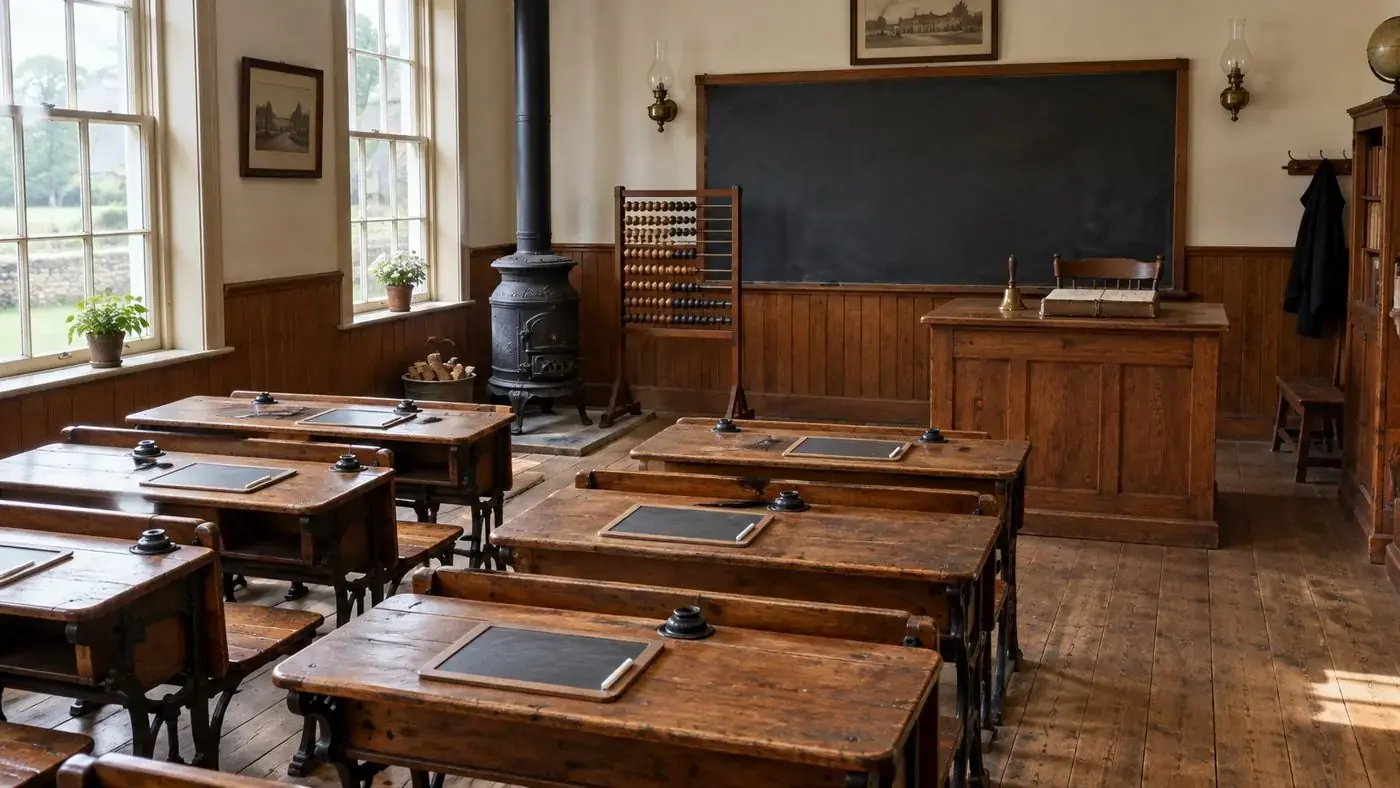
The day in a Victorian village school usually opened with prayers, a hymn and Scripture. Reading, writing and arithmetic followed, taught by "Standards", the grades against which children were examined each year. The younger ones mostly wrote on slates and the older ones in copybooks. Girls generally spent the afternoons on needlework, which the inspector also examined, while boys might do drawing or, later in the century, some elementary science or drill. Singing, geography and history were added as "class subjects", which earned extra grant. In a school of one or two rooms, a single teacher with a pupil-teacher or monitor could be in charge of children from infants up to twelve or thirteen all at once. That goes a long way to explain the rote learning and strict discipline described in so many memoirs of the period.
What school log books record
If you can find only one record of a Victorian village school, hope that it is the head teacher's log book. Entries are often brief, but over the years they build into a detailed account of rural life. They commonly cover:
- Farming and the seasons: absences for haymaking, harvest, gleaning, potato picking, bird scaring, acorn gathering and hop picking. The summer break was often timed to the harvest and called the "harvest holiday".
- Illness: outbreaks of measles, scarlet fever, whooping cough, diphtheria and mumps, sometimes with the school shut by order of the medical officer.
- Weather: snow, floods and heavy rain that stopped children making long walks across fields and down lanes.
- Visitors and events: calls from the rector or the managers, the squire's family, treats, club days, fairs and royal jubilees.
- Inspections: the annual visit of HM Inspector, and of the diocesan inspector for religious knowledge, often with the report copied out in full.
- Staff: appointments, pupil-teachers' examinations, and the teacher's own illnesses and resignations.
- Discipline and attendance: punishments, visits from the attendance officer, and remarks about irregular attenders.
Read the log book alongside the admission registers, which list children by name with dates of birth, parents and addresses. These can be matched against census returns and parish registers to follow families through time; our guide to tracing ancestors in North Hampshire explains how.
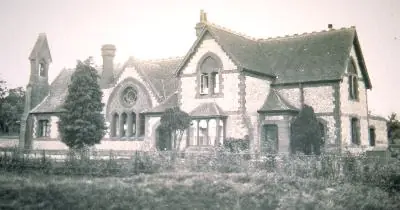
Typical village school buildings
A Victorian country school is usually easy to spot, even after it has been turned into a house. Look for:
- a single large schoolroom, sometimes with a smaller infants' classroom added later;
- tall windows, often pointed or Gothic in style, set high so that the children could not see out;
- a bellcote on the gable;
- a teacher's house attached at one end;
- a date stone or inscription naming the founder or the year it was built or enlarged;
- separate entrances or yards for boys, girls and infants.
Brick, flint and tile are the usual materials in this part of Hampshire. Our page on North Waltham's buildings gives local background, and the site's picture of North Waltham school shows the sort of building that served generations of village children.
Finding school records in Hampshire
- Hampshire Archives and Local Studies, Winchester. Many surviving log books, admission registers and managers' minutes have been deposited here and are catalogued under the school or the parish. Some may be closed for a period because they contain personal details of children.
- The school itself. If the school is still open, older log books are sometimes kept on site or by the diocese. It does no harm to ask.
- The National Archives. Series ED 21 (public elementary school files) and ED 7 (preliminary statements made for building grants) can include correspondence, plans and inspectors' notes.
- The Church of England Record Centre, which holds the National Society's school files, sometimes with grant applications and plans.
- Parish records and directories. Vestry minutes, parish magazines and trade directories such as Kelly's often mention the school, when it was founded, how big it was and who the teacher was.
- Census returns. Look for "scholar" against children's names, and for schoolmasters, schoolmistresses and pupil-teachers living in the parish.
Older records are full of unfamiliar words, and our glossary of old parish record terms may help with some of them.
Frequently asked questions
What was a National School?
A Church of England school supported by the National Society, which was founded in 1811. Most Victorian village schools in rural Hampshire were of this kind, and in practice the parish clergy ran them.
When did school become compulsory in England?
The 1880 Elementary Education Act made attendance compulsory between five and ten. Before that, the Acts of 1870 and 1876 had allowed school boards and attendance committees to make byelaws requiring children to attend.
When did village schooling become free?
From 1891, when a government fee grant let most elementary schools stop charging the weekly school pence.
Why are so many children marked absent in log books?
Children were needed for work on the farm and at home, above all at haymaking and harvest. Long walks in bad weather and outbreaks of infectious illness kept many more at home, and the log books record it all.
Where can I find a Hampshire village school's log book?
Start with the Hampshire Archives and Local Studies catalogue in Winchester. If nothing is listed there, ask the school or the diocese, and look at The National Archives' ED series for official files.
Further reading on this site
- Pastimes of the Village Pub: Traditional Games in Rural Hampshire
- The Farming Year in a Chalk Downland Parish
- How to Trace Your Ancestors from North Waltham, Steventon, Ashe and Deane
This guide was written for the restored archive by the society's volunteers. If you can add to it or spot a mistake, please get in touch through our contacts page.