Articles · Village history
Nonconformist chapels and meeting houses in rural Hampshire
In brief
- Nonconformists in rural Hampshire included Independents, Baptists, Wesleyan and Primitive Methodists, each with different origins and organisation.
- Our North Waltham church page notes villagers deserting St Michael's for Nonconformist services by 1803; the detailed local story is still to be traced.
- The 1851 Religious Census (HO 129) recorded sittings and attendance for every place of worship on 30 March 1851.
- Chapel registers surrendered in 1837 are at The National Archives in RG 4; later records are mostly at Hampshire Archives.
- Meeting house licences, preachers' plans and old Ordnance Survey maps help find congregations that left no surviving building.
Contents
Our page on St Michael's, North Waltham records that villagers were "deserting St Michael's in favour of Nonconformist services by 1803". It is a short phrase, but it opens up a large subject. Across rural Hampshire in the late eighteenth and nineteenth centuries, a significant minority of country people chose to worship outside the parish church, in a licensed cottage, a hired room or, eventually, a small chapel of their own. This article explains who the main Nonconformist groups were, why villagers joined them, what the 1851 Religious Census tells us, and where to find the registers and buildings they left behind. We have not yet traced the detailed history of Nonconformity in North Waltham, Steventon, Ashe or Deane, so the emphasis here is on the sources.
Who were the Nonconformists?
"Nonconformist", or "Dissenter" in older usage, covers any Protestant who worshipped outside the Church of England. The groups most likely to appear in north Hampshire villages fall into two families: the older Dissenting churches that went back to the seventeenth century, and the Methodist bodies that grew out of the eighteenth-century revival.
| Denomination | Origins | Typical features in rural Hampshire |
|---|---|---|
| Independents (later Congregationalists) | Seventeenth-century Puritan congregations; each church self-governing | Strongest in market towns; village preaching stations often run from a town chapel |
| Baptists | Seventeenth century; believers' baptism by immersion | Particular (Calvinist) and General Baptist churches in towns, with village outposts |
| Wesleyan Methodists | John Wesley's revival from the 1730s; separated from the Church of England after his death in 1791 | Organised in circuits served by travelling ministers and local preachers |
| Primitive Methodists | Split from the Wesleyans in the early 1800s; open-air camp meetings | Reached north Hampshire in the 1830s; strong among farm labourers; small, plain chapels |
| Society of Friends (Quakers) | Seventeenth century | Few rural meetings by the nineteenth century; kept careful registers of their own |
The Independents and Baptists had meeting houses in Basingstoke and other towns from an early date. Methodism arrived later; John Wesley himself visited Basingstoke on his preaching tours. The Primitive Methodists, sometimes nicknamed "Ranters", reached this part of the county in the early 1830s. Sherfield on Loddon was missioned in December 1833, and Hampshire Archives holds records of a Primitive Methodist circuit based at Micheldever, including a baptism register beginning in 1835. Later in the century the Wesleyan and Primitive branches, with others, came together in the Methodist Union of 1932.
Why villagers left the parish church
The reasons people gave, and the reasons historians have suggested, overlap but are not identical. For a parish like North Waltham we cannot say from the 1803 remark alone which mattered most. The usual explanations are these:
- Absent or overstretched clergy. Many Georgian parishes were held in plurality, with the incumbent living elsewhere and a curate taking one service a Sunday, sometimes across two or three churches.
- Preaching and singing. Methodist and Dissenting services offered extempore preaching, lively hymns and prayer meetings that many found more direct than the Prayer Book liturgy.
- Lay leadership. Labourers and craftsmen could become class leaders and local preachers, a responsibility the parish church rarely gave them.
- Social independence. In a village where the squire and parson held the land, the chapel was a space that belonged to its members.
- Convenience. A cottage meeting at a hamlet could be closer than the parish church, and held at a time that suited working people.
Attendance at chapel did not always mean leaving the church completely. Plenty of people went to church in the morning and chapel in the evening, and almost everyone continued to be married in the parish church until 1837, because the law gave them little choice, and buried in the churchyard because there was often no alternative.
Licensing a meeting place
Under the Toleration Act of 1689, Protestant Dissenters could worship legally provided their meeting place was registered with the bishop, the archdeacon or the justices at quarter sessions. Early village congregations commonly registered an ordinary house, so a licence naming "the dwelling house of" a local man is often the first evidence of Nonconformity in a parish. For our area, the Winchester diocesan records and Hampshire quarter sessions papers at Hampshire Archives are the places to look. We have not yet searched them for our four parishes.
The 1851 Religious Census
On Sunday 30 March 1851, alongside the ordinary population census, the government took a census of every place of worship in England and Wales. The minister, steward or other official of each church and chapel filled in a form giving:
- The name and denomination of the place of worship, and when it was erected or first used.
- Whether it was a separate building used only for worship.
- The number of free and other sittings.
- The number attending morning, afternoon and evening services that day, with Sunday scholars counted separately.
- Any remarks the informant wanted to add, which are sometimes the most revealing part.
Horace Mann's report on the results was published in 1854 and caused a stir. It showed that a large part of the population attended no service at all that day, and that Nonconformist attendances were close to rivalling those of the Church of England. Church leaders disputed the methods, and the exercise was never repeated, which makes 1851 a unique snapshot.
The original returns survive at The National Archives in series HO 129, arranged by registration district and then by parish. Check which registration district each of our villages belonged to in 1851 before you search, since parishes on the edge of the Basingstoke area were not always grouped with the town. The returns can be viewed online through the commercial family history sites and on microfilm, and published transcripts exist for some counties. The My Primitive Methodists website also gathers the Hampshire returns for Primitive Methodist chapels. When you find the return for a village chapel, compare the stated date of erection with the licensing records and any datestone on the building itself; the three do not always agree.
Nonconformist registers and other records
Nonconformist baptisms and burials were not recorded in the parish register, unless the family also had a child baptised in church, which happened more often than you might think. When civil registration began in 1837, the Registrar General collected registers from chapels across the country, and a second collection followed in 1857. These are now at The National Archives.
| Record | Where | Notes |
|---|---|---|
| Registers surrendered in 1837 | The National Archives, RG 4 | Births and baptisms mostly; some burials; indexed online |
| Registers surrendered in 1857, and Quaker registers | The National Archives, RG 6 and RG 8 | Smaller collections; some reunited with RG 4 |
| Dr Williams's Library birth registry | The National Archives, RG 5 | Central registration of Dissenters' births, used by some families from the 1740s to 1837 |
| Circuit and chapel records after 1837 | Hampshire Archives | Later baptism registers, minute books, preachers' plans, trust deeds |
| Meeting house licences | Hampshire Archives (diocesan and quarter sessions records) | Often the earliest evidence of a congregation |
The RG series are indexed and searchable on several family history websites. If a family vanishes from the parish baptism register for a few years and then reappears, a gap of that kind is often a sign that they were attending chapel. Our guide to tracing ancestors in north Hampshire explains how to combine these with parish registers and the census. Preachers' plans, the printed sheets showing which local preacher was to take which service, are particularly useful for village history because they list every place where a circuit held regular worship, including places with no chapel building.
Chapel buildings
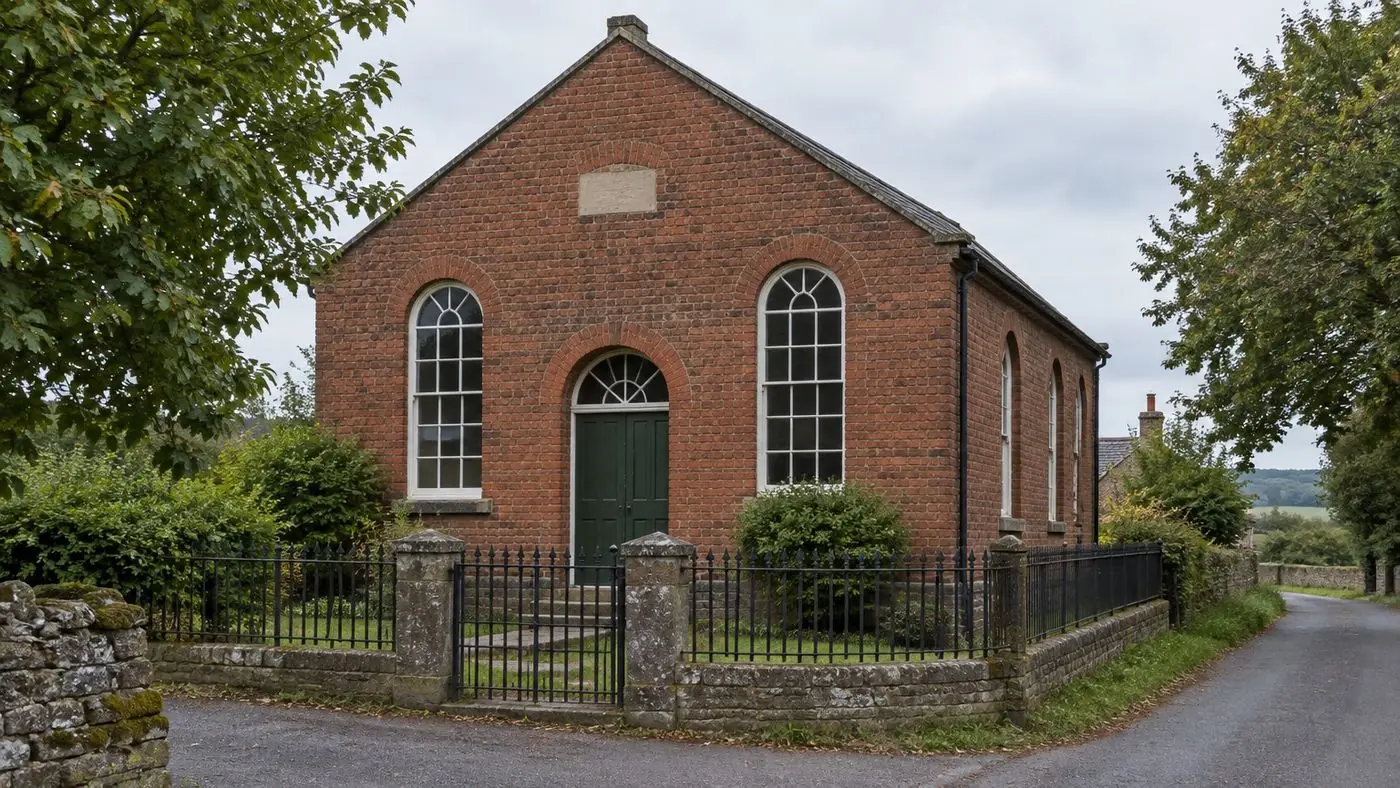
Village chapels were usually small, plain rectangles of brick, or brick and flint in this part of Hampshire, with a gable end facing the road and a datestone or name tablet above the door. Many were built by the congregation themselves on a plot leased or sold by a sympathetic owner, which in a village dominated by one estate was not always easy to obtain. That is one reason some congregations met in cottages for decades before they had a building.
Most rural chapels closed during the twentieth century as congregations declined, especially after the Methodist Union led circuits to merge neighbouring societies. Many have been converted to houses, and the giveaway is often the shape: a single tall room with large round-headed or pointed windows, a datestone, or a small burial ground behind. Old Ordnance Survey maps at 25 inches to the mile usually mark a chapel and often its denomination, which is a quick way to check whether a building in one of our villages started life as one.
We would welcome information on any chapel or meeting house in North Waltham, Steventon, Ashe or Deane, whether a surviving building, a photograph, a licence or a mention in a preachers' plan. At present the 1803 reference on the North Waltham church page is the main firm statement we hold, and it deserves to be followed up.
Frequently asked questions
Was there a chapel in North Waltham?
The North Waltham church page records villagers attending Nonconformist services by 1803, but we have not yet confirmed where they met or whether a chapel was built. Meeting house licences, the 1851 Religious Census and old Ordnance Survey maps are the sources to check.
Where are Nonconformist baptism registers kept?
Registers surrendered in 1837 are at The National Archives in RG 4, with smaller collections in RG 5, RG 6 and RG 8. Later registers usually stayed with the circuit or chapel and many are now at Hampshire Archives.
Why are Nonconformists buried in the parish churchyard?
Before the mid nineteenth century most villages had no other burial ground, and parishioners had a right to burial in the churchyard whatever their denomination. Their burials therefore usually appear in the parish register.
What were the Primitive Methodists?
A Methodist body that broke away from the Wesleyans in the early nineteenth century, known for open-air camp meetings and a strong following among labourers. They reached north Hampshire in the 1830s and rejoined other Methodists in 1932.
How do I find a chapel's 1851 Religious Census return?
The returns are at The National Archives in series HO 129, arranged by registration district and parish. They can be viewed online through family history websites or on microfilm.
Further reading on this site
- Pastimes of the Village Pub: Traditional Games in Rural Hampshire
- Victorian Village Schools in Rural Hampshire
- The Farming Year in a Chalk Downland Parish
This guide was written for the restored archive by the society's volunteers. If you can add to it or spot a mistake, please get in touch through our contacts page.