Articles · Research guides
How to Research a First World War Soldier from a Hampshire Village
In brief
- Begin with the war memorial and any parish roll of honour, and copy them exactly.
- About two-thirds of soldiers' service records burned in 1940, so expect to use several sources together.
- CWGC, medal index cards and Soldiers Died in the Great War help confirm who a man was and where he served.
- The 1911 and 1921 censuses and the 1918–19 Absent Voters' Lists tie a man to his village.
- Record memorials with photographs and careful transcription; never take rubbings or clean the stone.
Contents
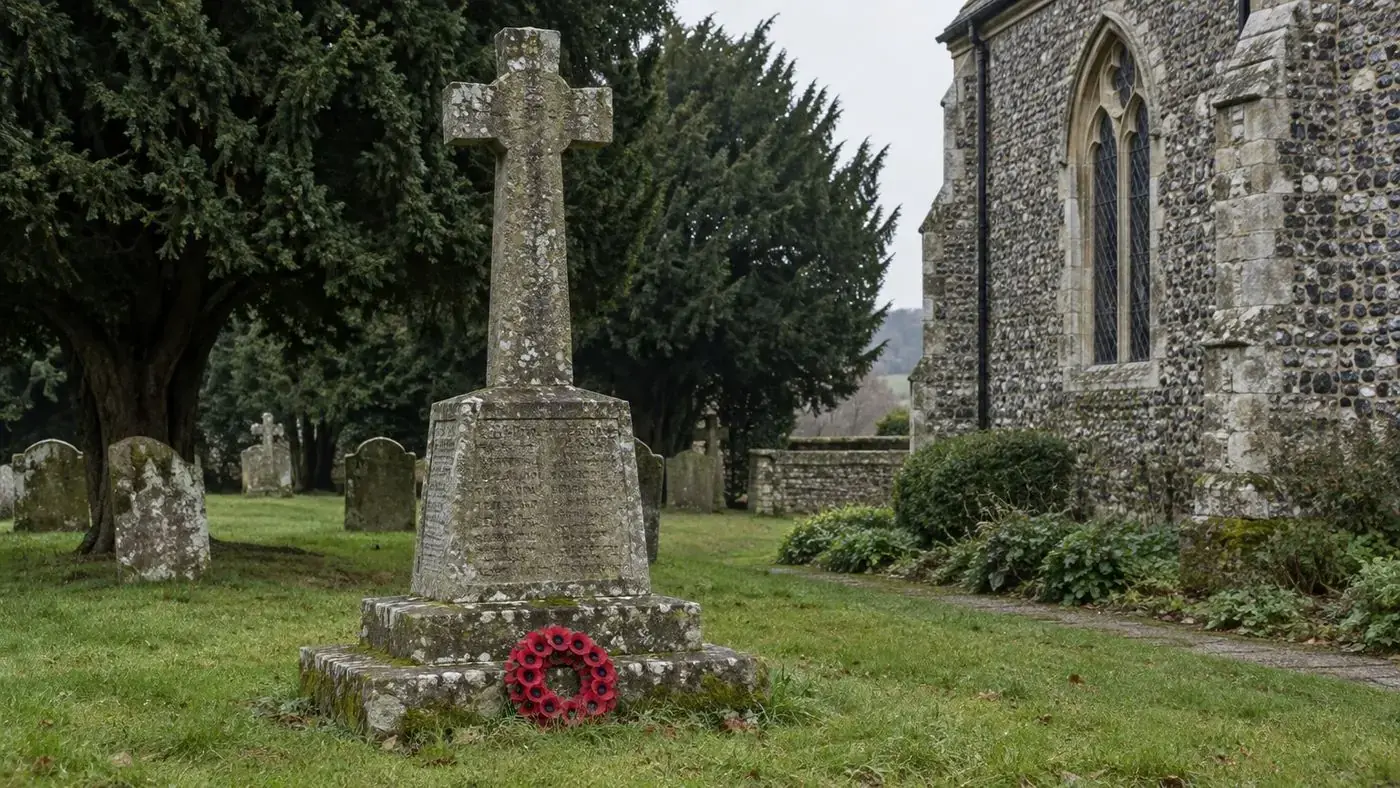
Nearly every village in North Hampshire has its list of First World War names somewhere. It may be carved on a cross by the churchyard gate, painted on a board inside the church, or printed in a parish magazine that has survived in a box at the record office. For many of us, that list is where the questions start. Who was he, where did he live, what did he do before 1914, and how did he die? This guide sets out a practical way of answering them for a soldier from a rural parish such as North Waltham, Steventon, Ashe or Deane, using sources that are free or easy to get at.
The same method works for the men who came home. They are often harder to trace than the fallen, since nobody put up a memorial to them, but most of the records below cover them as well.
Start with the memorial and the roll of honour
A war memorial is a primary source, but it is where the work begins, not where it ends. First write down exactly what it says: the order of the names, any initials, ranks, regiments or dates, and whether the list runs alphabetically, by date of death or by rank. The small things count. A man shown only by an initial may have gone by his middle name in the village, and the regiment given may be the one his family remembered rather than the one he was serving with when he died.
Rolls of honour and parish records
Many parishes kept a roll of honour while the war was still going on. It listed everyone from the parish who was serving, not just those who were killed, and might be framed in the church, printed in the parish magazine or entered in the vestry minutes. If one survives, hold on to it: it tells you which men the village counted as its own. Ask at the church, look at the church's own history (our page on North Waltham church gives some local background, as does the material on Steventon church), and search the Hampshire Archives catalogue for parish deposits.
Why names appear, or do not
Memorials were put together by local committees between about 1919 and the early 1920s, mostly from names that families brought forward. No national rule said who should be included. One man might be named in the parish where he was born, in the parish where his parents lived and in the town where he worked; another might appear on none of them because his family had moved on. An absence from a memorial proves nothing either way.
The key national sources
With a name in hand, the next job is to find the right man in the national records. Common surnames make this slow, and you should collect several separate pieces of evidence before settling on an individual.
Commonwealth War Graves Commission
The Commonwealth War Graves Commission (CWGC) was founded in 1917 as the Imperial War Graves Commission. It records servicemen and women who died between August 1914 and 31 August 1921. The free online database gives the place of burial or commemoration, service number, unit and date of death. Often there is also a line of family detail added in the 1920s, such as the parents' names and a home address, and that line is frequently what ties a name on a village memorial to one particular soldier.
Soldiers Died in the Great War
Soldiers Died in the Great War was published by HMSO in 1921 in some eighty parts. It lists army officers and other ranks who died, with place of birth, place of enlistment and, for many, place of residence, and can now be searched on the main commercial family history websites. It was compiled from army records and has its share of mistakes, but birthplace and place of enlistment are just what you need to prove a village connection.
Service and pension records, and the "burnt documents"
Where an individual service record survives, it is the fullest source of all. Many do not. In September 1940 a German air raid set fire to the War Office record store at Arnside Street in south London, and The National Archives reckons that roughly two-thirds of the soldiers' documents kept there were lost. What came through, often scorched and water-stained, now forms series WO 363, known to researchers as the "burnt documents". A second series, WO 364 (the "unburnt documents"), is made up largely of papers pieced back together from Ministry of Pensions files for men discharged with a pension. Between them they cover perhaps a third of the men who served. Both have been digitised and can be seen on the major family history websites.
A surviving record may give a physical description, next of kin, home address, trade, conduct sheet, postings and medical history. If there is nothing for your man, carry on regardless; the sources below can put back a good deal of the story.
Pension cards
The Ministry of Pensions also kept index cards for pensions paid to disabled soldiers and to widows and dependants. The cards are held by the Western Front Association and can be searched online. They may give a widow's address and the children's names, which is particularly useful for families who stayed on in a village after the war.
Medal index cards
Almost every soldier who served overseas earned at least one campaign medal, and the Army Medal Office noted it on a medal index card (National Archives series WO 372). The cards amount to a near-complete roll of the men who went abroad, so for a survivor they are often the only national record there is. A card can show units and numbers, the theatre of war, the date he first entered it if that was before the end of 1915, and now and then an address. The fuller medal rolls in WO 329 add more about units.
Local and regimental sources
The Royal Hampshire Regiment Museum
Many of our men served with the Hampshire Regiment, which did not become the Royal Hampshire Regiment until 1946. Plenty of others joined different regiments, the Royal Navy or other corps. The Royal Hampshire Regiment Museum at Serle's House, Southgate Street, Winchester, holds the regimental history, photographs and published accounts, and its staff and volunteers can sometimes help with enquiries. Battalion war diaries, which record movements day by day, are at The National Archives in WO 95, and many are digitised. Once you know a man's battalion and date of death, the war diary will usually show what his unit was doing at the time.
Local newspapers
Papers such as the Hampshire Chronicle and the Basingstoke papers printed casualty lists, letters home, photographs and short obituaries. Many can be searched through the British Newspaper Archive, and Hampshire libraries and archives hold copies. A short paragraph about a local lad wounded at the front may give you a parent's name, a former employer or the farm he worked on.
Census records: 1911 and 1921
The 1911 census is the best picture of the household a soldier grew up in, with ages, birthplaces, occupations and the address. The 1921 census, released in 2022, shows who came back and where they were living, and often who they worked for. For using the census across a whole village, see our article on tracing ancestors in North Hampshire.
Absent Voters' Lists, 1918–19
The Representation of the People Act 1918 widened the vote and created Absent Voters' Lists for men serving away from home. They were drawn up from the autumn of 1918 into 1919 and give service number, rank and unit next to a home address. In a small parish they come close to a ready-made roll of who was still in uniform. Hampshire Archives holds the county's electoral registers.
Sources at a glance
| Source | What it tells you | Where to find it |
|---|---|---|
| War memorial and roll of honour | Who the parish remembered; sometimes rank and unit | Church and churchyard; parish records at Hampshire Archives |
| CWGC database | Burial or commemoration, unit, number, date of death, often next of kin | CWGC website (free) |
| Soldiers Died in the Great War | Place of birth, enlistment and residence | Commercial family history websites; reference libraries |
| Service records (WO 363, WO 364) | Physical description, family, postings, conduct, medical history | The National Archives, via Ancestry and other websites |
| Pension index cards | Disability, widow's and dependants' details, addresses | Western Front Association, via Fold3 or similar |
| Medal index cards (WO 372) | Units, numbers, theatre of war; proof of overseas service | The National Archives (free to search); commercial sites |
| Battalion war diaries (WO 95) | What the unit was doing day by day | The National Archives, many digitised |
| Local newspapers | Casualty reports, letters, photographs, obituaries | British Newspaper Archive; Hampshire libraries |
| 1911 and 1921 censuses | Household before and after the war | Commercial websites; 1921 via Findmypast |
| Absent Voters' Lists | Number, unit and home address of men still serving | Hampshire Archives, Winchester |
Common pitfalls
- Taking the first match as the right man. Hampshire had plenty of men with the same name, so look for at least two independent facts that agree, such as birthplace and parents' names.
- Relying on one transcription. Online indexes are made by people and contain misreadings; look at the image of the original whenever you can.
- Mixing up regiments and battalions. Men were often transferred, and the unit given on the memorial, in Soldiers Died and by the CWGC can all differ quite legitimately.
- Reading too much into gaps. A missing service record usually means it burned in 1940, not that the man never served.
- Leaving out the Navy, the Royal Flying Corps and women. Naval and air service records are separate series, and women served as nurses and in the auxiliary corps.
- Repeating family stories as fact. Oral tradition is worth recording, but record it as tradition until documents back it up.
How to record a memorial respectfully
Recording a memorial is quiet, careful work. A few rules of thumb:
- Ask first. Tell the churchwardens or the parish council what you are doing, particularly if you want to take photographs inside a church.
- Leave the stone alone. No wire brushes, chalk, shaving foam or rubbings. Light from a torch held at a low angle, or a low sun, will usually bring up worn lettering.
- Transcribe exactly. Copy spelling, punctuation and layout as they stand, and note anything you think is a mistake separately.
- Photograph the whole and the detail: an overall view showing the setting, then each panel, with a scale if you have one.
- Record the context. Note the location, the materials, any dedication date that is actually carved, and the condition.
- Share what you have done. The Imperial War Museum's War Memorials Register welcomes information, and a copy deposited with Hampshire Archives will save the next researcher a great deal of time.
When you write up a man's life, bear in mind that his descendants may still live nearby. Keep to the facts, do not speculate about how he died, and say where your information comes from.
A Second World War contrast
The Second World War came closer to home, with Air Raid Precautions wardens, the Home Guard and evacuees in country parishes. The site's articles page includes a photograph of a local ARP team. The records for that war are a different matter again: most Second World War service records are still held by the Ministry of Defence, and the 1939 Register stands in for a census. The approach in this guide still holds, though. Start in the village and work outwards.
Frequently asked questions
Can I still find a First World War soldier if his service record was destroyed?
Usually, yes. Around two-thirds of soldiers' records were lost in 1940, but medal index cards, CWGC entries, Soldiers Died in the Great War, war diaries, pension cards, newspapers and Absent Voters' Lists can between them rebuild much of a man's service.
Why is a soldier from our village missing from the war memorial?
Names were mostly put forward by families, and there was no national rule about who qualified. A man might be named where his parents later lived, where he worked, or nowhere at all if the family had left. His absence does not show that he did not serve or die.
Where are Hampshire's Absent Voters' Lists kept?
Hampshire Archives and Local Studies in Winchester holds the county's electoral registers, which include the Absent Voters' Lists drawn up from 1918. Check the catalogue or get in touch with the archive before you visit.
Does the Royal Hampshire Regiment Museum hold individual service records?
No. Individual service records are national records, held by The National Archives and published online. The museum in Winchester has regimental history, photographs and published material, and can help you set a soldier's service in context.
Is it acceptable to take a rubbing of a war memorial?
Best not. Rubbings, chalk and cleaning products can damage the stone and the lettering. Photographs taken with light from a low angle, with permission where it is needed, are the safest way to record an inscription.
Further reading on this site
- How to Trace Your Ancestors from North Waltham, Steventon, Ashe and Deane
- How to Read a Tithe Map and Apportionment: A Steventon Example
- Turnpike Roads and Coaching Inns Around Basingstoke
This guide was written for the restored archive by the society's volunteers. If you can add to it or spot a mistake, please get in touch through our contacts page.