Articles · Research guides
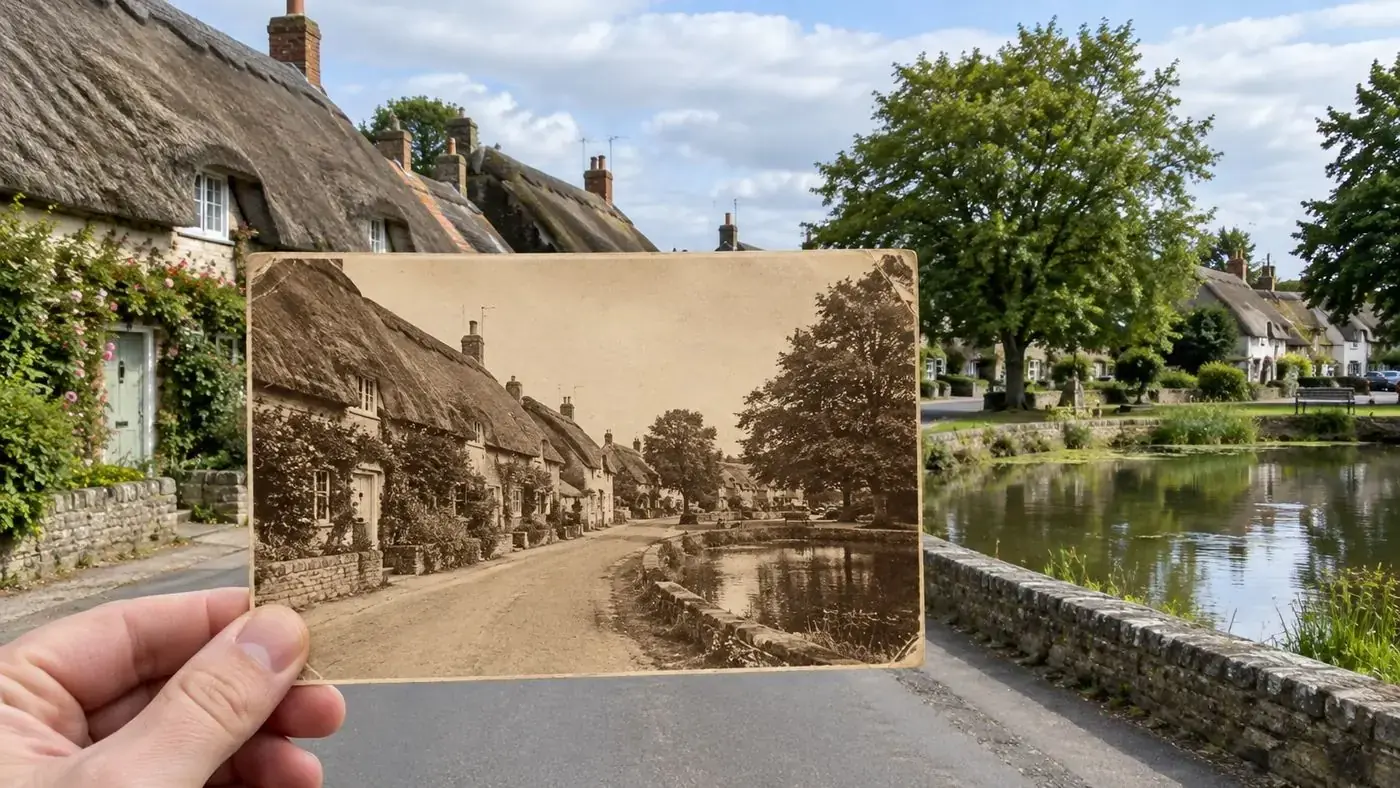
How to Make a “Then and Now” Photographic Record of Your Village
In brief
- A matched pair of old and new photographs records change in a village more exactly than a written description.
- Family albums, postcards, the county record office and the Historic England Archive are the main places to find old pictures.
- Find the viewpoint by lining up fixed features, then match the height, lens, season and time of day.
- Ask before going on to private land or publishing pictures you have borrowed.
- Caption everything, put details in the file metadata, keep backups and deposit copies with the county record office.
Contents
Lay an old photograph of a village street beside one taken from exactly the same spot today and the differences are obvious at once: a cottage gone, the road widened, a pond filled in or cleared out, a sapling grown into a big tree. What has stayed the same is often just as interesting. "Then and Now" photography, also called repeat photography or rephotography, is a good project for a local history group or for one person working alone, and it needs no special kit. This guide explains how to do it properly, with examples from North Waltham, Steventon, Ashe and Deane.
Why repeat photography matters
Villages change slowly enough that the people living in them seldom notice. Over fifty or a hundred years, though, it all adds up. A carefully matched pair of photographs records the change more exactly than any description in words, and can show:
- buildings pulled down, extended, re-roofed or given new fronts;
- alterations to roads, verges, pavements and street furniture;
- trees, hedges and orchards that have grown up or disappeared;
- changes of use, such as a farmyard turned over to housing;
- the small details of daily life, from shop signs to clothes and vehicles.
There is also the simple point that today's "now" is tomorrow's "then". A modern picture with a proper caption, properly archived, will be a historical document for whoever repeats the exercise in fifty years.
The society has already produced a "Then and Now" booklet for North Waltham, pairing historic views of the village with modern photographs. The photo galleries on this site for Steventon, Deane and North Waltham have plenty of old views to start your own survey from.
Finding old photographs
Family albums and local people
The best source is usually the village itself. Families who have been there a long time often have albums, loose prints and postcards that have never left the house. A notice in the parish magazine, a table at a village event or a word in the pub can turn up surprising things. Always note who lent each picture, and make a careful copy rather than hanging on to the original for months.
Picture postcards
From the early twentieth century publishers produced postcards of quite small villages, showing the church, the pond, the main street or the school. They turn up at postcard fairs and online, and many can be dated from the postmark or the message on the back. The photographer usually picked the prettiest viewpoint, which helps when you are trying to find it again.
Archives and collections
Public collections worth searching include:
- Hampshire Record Office in Winchester, which holds photographs, postcards and illustrated sale particulars, and can tell you about other local collections;
- the Historic England Archive, the national collection of photographs of England's buildings and places, much of it searchable online;
- aerial photography collections, including historic aerial views of England, which are especially useful for showing how a whole village has changed;
- local museums and libraries, and the collections of neighbouring history societies.
Write down the reference number of every archive image you use. You will need it to cite the source and to ask permission to publish.
Locating the exact viewpoint
This is the skill that matters most. A "now" picture taken from roughly the right place is interesting enough, but one taken from exactly the right place tells you far more.
- Find fixed points. Look for things that are unlikely to have moved: the church tower, an unusual chimney, a boundary wall, a road junction, the line of a roof.
- Line them up. Two fixed points that overlap in the old photograph give you a line the camera must have been on. A second pair gives you a second line, and the camera stood where the two cross.
- Check the height. Old cameras were often on tripods at chest or eye level, but some photographers stood on carts, walls or upstairs windowsills. Compare how much roof and how much ground you can see.
- Take the picture with you. A copy of the old photograph on a phone or tablet, or better still a print, lets you compare on the spot.
- Record where you stood. Note a grid reference or GPS coordinates and the compass direction, so the view can be found again.
Sometimes the original viewpoint has gone, perhaps under a new building or in the middle of a busy road. Then take the nearest safe position you can, and say so in the caption.
Camera and phone technique
Lens and framing
Matching the field of view matters as much as matching the position. Many early photographs were taken with lenses roughly equivalent to a standard or slightly wide focal length. Phones default to a wide lens, which makes distant things look smaller than in the original, so use the 2x setting or a camera's zoom to match the framing, and avoid digital zoom where you can because it loses quality. Keep the camera level. Tilting it up to get a tall building in introduces distortion that the old picture may not have.
Season and time of day
Try to match the season, because of the leaves, and the time of day, because of the shadows. The shadows in the old picture are a useful clue, as their direction and length tell you roughly when it was taken. With the trees bare, winter photographs often show buildings more clearly, so they can be worth taking in addition to the seasonal match.
Quality and quantity
Shoot at the highest resolution your device allows. Take several frames, including one a little wider, so that you have room to crop to the original. If the old picture is upright, take yours upright too.
Permissions and private land
Many of the best viewpoints are on private ground: a front garden, a farmyard, a field. Always ask the owner before going on, explain what you are doing, and offer a copy of the result; most people are pleased to be asked. Otherwise keep to public rights of way, and take care on roads and verges. No photograph is worth an accident.
Be considerate about people's homes. A historic view of a cottage is part of the public record, but a modern close-up of someone's front window can feel intrusive. Do not photograph identifiable children without their parents' consent, and leave out house numbers and other details residents may not want shared.
Copyright in old photographs can be complicated. In the UK it usually lasts a long time after the photographer's death, and the rules for older and unpublished pictures vary. Archive images normally come with a licence. Ask the lender or the archive how a picture may be used, write the answer down, and take advice if you are unsure.
Captioning and archiving
An uncaptioned photograph soon loses most of its value. For every pair, record at least:
- the place, with a grid reference or coordinates;
- the date, or approximate date, of the old picture and how you arrived at it;
- the source, owner and reference number of the old picture;
- the date, time and photographer of the new one;
- a short note of the main changes you can see.
Put the key details into the file's own metadata as well as into a spreadsheet or catalogue, using the description, creator and copyright fields that most photo software provides. Stick to one file-naming scheme (parish, place, date and a sequence number, for instance) so that files sort sensibly and pairs can be matched. Keep the master copies in an uncompressed or high-quality format, with at least one backup kept somewhere else.
Lastly, deposit copies with a permanent institution. Hampshire Record Office will advise on depositing digital and printed photographs together with their captions, and a copy there will outlast any personal hard drive or society website.
Publishing your survey
There are plenty of ways to share a finished survey. You could produce a printed booklet like the society's North Waltham "Then and Now", put on an exhibition in the church or village hall, run a series in the parish magazine, or set up an online gallery. Side-by-side layouts are the simplest; online, slider tools that let the viewer wipe between old and new work well. Credit every lender and archive, and give contact details so readers can send corrections and more pictures. Our contacts page explains how to offer material to this archive.
Then and Now checklist
| Stage | Task | Tip |
|---|---|---|
| Collect | Gather old images from families, postcards and archives | Record lender and reference for every image |
| Research | Date each image and identify the view | Use postmarks, vehicles, clothing and maps |
| Locate | Find the viewpoint from fixed features | Line up two overlapping features |
| Permission | Ask landowners and archives | Offer owners a copy of the result |
| Photograph | Match position, height, lens and season | Use 2x or zoom on phones; keep level |
| Caption | Write full captions for both images | Embed details in file metadata |
| Archive | Name, back up and deposit copies | Offer a set to the county record office |
| Publish | Booklet, exhibition or online gallery | Credit sources and invite corrections |
For more on the villages covered by this archive, see the pages on North Waltham, Steventon and Ashe.
Frequently asked questions
What is a Then and Now photograph?
A pair of pictures of the same view, one old and one new, with the new one taken as near as possible to the original position so the two can be compared directly.
Where can I find old photographs of my village?
Start with local families and their albums. After that, try picture postcards, the county record office, the Historic England Archive, aerial photography collections, local museums and neighbouring history societies.
Can I use my phone for a Then and Now survey?
Yes. Use the highest resolution and keep the phone level. Switch to the 2x lens or an optical zoom rather than the default wide lens, so the framing matches the narrower view of most older photographs.
Do I need permission to stand on private land?
Yes. Ask the owner before going on to private property, explain the project and offer a copy of the picture. Otherwise keep to public roads and rights of way, and mind the traffic.
How should I store the finished photographs?
Keep high-quality master files with consistent names, put the captions into the file metadata, keep at least one backup somewhere else, and deposit a captioned set of copies at the county record office.
Can I publish old photographs I have been lent?
Only with permission. Ask the owner or the archive how the picture may be used and keep a note of the answer. Copyright in old photographs can last a long time, so take advice if you are not sure.
Further reading on this site
- How to Trace Your Ancestors from North Waltham, Steventon, Ashe and Deane
- How to Read a Tithe Map and Apportionment: A Steventon Example
- Turnpike Roads and Coaching Inns Around Basingstoke
This guide was written for the restored archive by the society's volunteers. If you can add to it or spot a mistake, please get in touch through our contacts page.
You may also like
- Pastimes of the Village Pub: Traditional Games in Rural Hampshire
- Village trades and crafts: blacksmiths, carriers and the village shop
- The Poor Law in Our Villages: From Parish Overseers to Basingstoke Workhouse
- The Society and its publications
- How to Research a First World War Soldier from a Hampshire Village